A small Lancehead (Fer De Lance) I came across on a trail as I set off on a long solo hike in the Peruvian Amazon a couple of years ago. These snakes can be anywhere and everywhere, from the ground to trees, and quite easy to miss.

A small Lancehead (Fer De Lance) I came across on a trail as I set off on a long solo hike in the Peruvian Amazon a couple of years ago. These snakes can be anywhere and everywhere, from the ground to trees, and quite easy to miss.

Coachwhips are out and about on even the hottest days, rarely active at night. But they can still be found where they sleep, which is often up in trees high off the ground. We spotted this one doing just that just above eye level on a late night hike. These long, slender snakes are great climbers, and this is a reasonably safe spot for such an animal to evade predators and get off the hot ground.

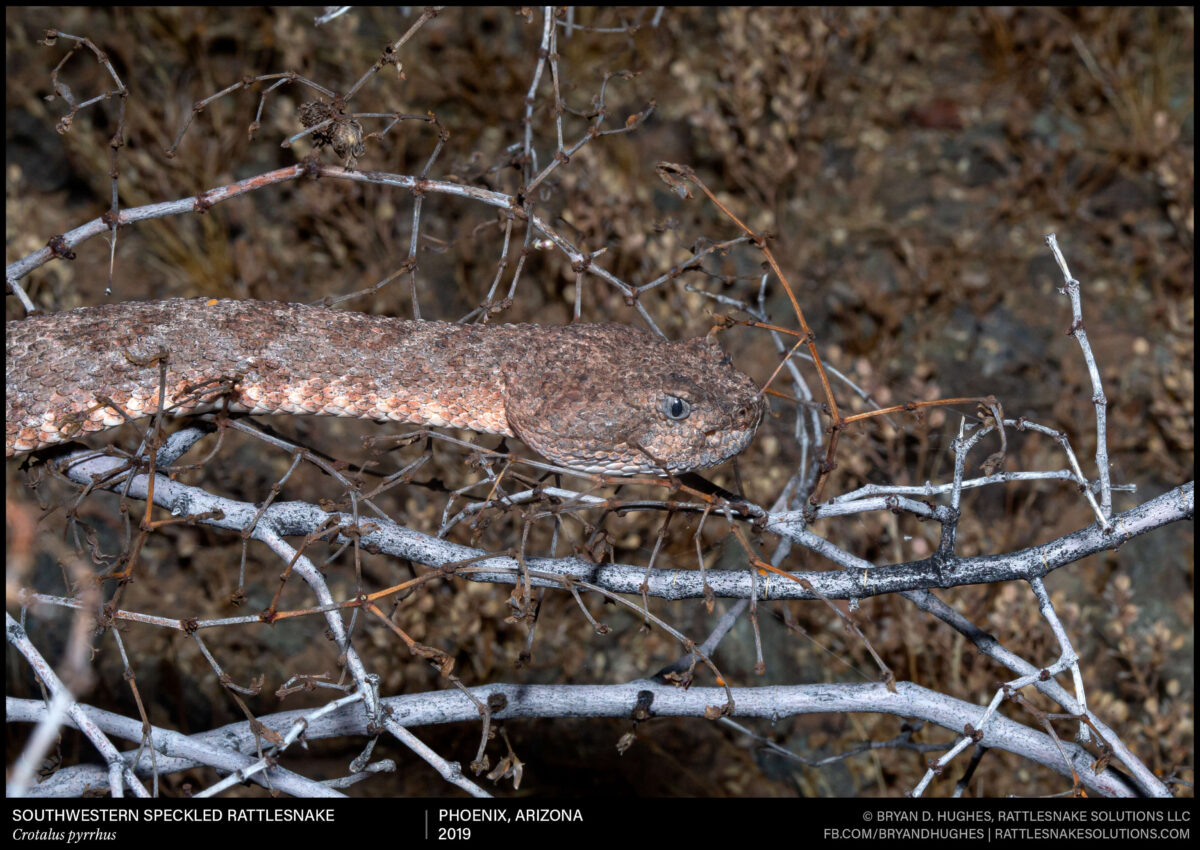
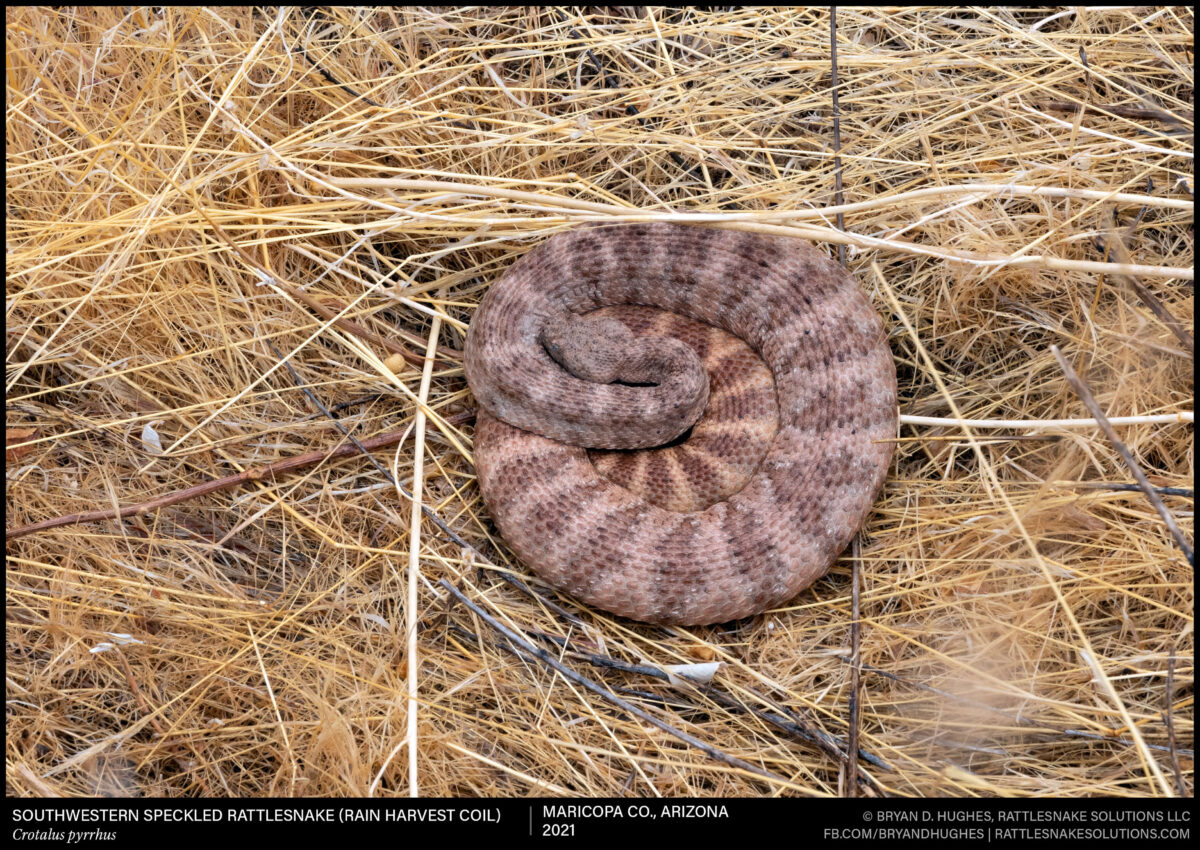
A rattlesnake that looks like a rock. This Southwestern Speckled Rattlesnake was found in central Arizona in an area of rusty granite and quartz. The resulting cryptic pattern is just as colorful, including speckled grey blue eyes. Though it is brightly colored, these snakes can be very difficult to see in context.

Cochran, C. (2019). Variation in morphology, diet, and venom composition in Crotalus pyrrhus (Cope 1867) [Doctoral dissertation, Loma Linda University]. Loma Linda University Electronic Theses, Dissertations & Projects. https://scholarsrepository.llu.edu/cgi/viewcontent.cgi?article=3590&context=etd
Crowell, H. L., Whelan, J. M., & Harmel, M. V. (2020). Rattlesnake colouration affects detection by predators. Journal of Zoology, 310(1), 1–11. https://doi.org/10.1111/jzo.12786
Hanscom, R. J., & Higham, T. E. (2023). Ambush hunting in snakes: Behaviour, function, and diversity. In Snakes: Ecology, behavior, and conservation (pp. 1–32). ResearchGate. https://www.researchgate.net/publication/373257803_Ambush_Hunting_in_Snakes_Behavior_Function_and_Diversity
Hanscom, R. J. (2025). From ambush to activity: Using accelerometry to reveal cryptic behaviors of rattlesnakes and kangaroo rats [Doctoral dissertation, University of California, Riverside]. eScholarship. https://escholarship.org/content/qt4ft2985w/qt4ft2985w.pdf
Teshera, M. S. (2021). Strike-induced chemosensory searching, kleptoparasitism, and the possibility of chemical crypsis in rattlesnakes [Doctoral dissertation, University of Texas at El Paso]. UTEP Digital Commons. https://scholarworks.utep.edu/cgi/viewcontent.cgi?article=4357&context=open_etd
A Twin Spotted Rattlesnake at her high elevation retreat. Accessing these areas is somewhere between difficult and impossible, but they’re perfect for a small montane rattlesnake.

A small Banded Rock Rattlesnake in ambush along the base of a boulder in southeastern Arizona. The pattern and bands break up its shape, making it difficult to see in context. This is a good way to catch one of the many Yarrows Spiny Lizards jumping around on the same rocks each morning.

A Southwestern Speckled Rattlesnake in ambush on a humid night a couple of years back. Like many other desert reptiles, the monsoon and period after are the most active times of year. Humid air and cooler, stable temperatures make for safer activity, and a lot has to be done in a relatively short amount of time.

Southwestern Speckled Rattlesnake (Crotalus pyrrhus)
A Rosy Boa found on a late night hike in Baja California Sur, Mexico a few years back.

A Twin-Spotted Rattlesnake with a relatively drab pattern, but not atypical for an older adult. These are small snakes, rarely seen by hikers, as their range within the U.S. consists of only a handful of mountains in southeastern Arizona. In addition to rodents, these rattlesnakes also specialize in lizards, often taking the colorful Yarrows Spiny Lizards also common to rocky outcrops in high pine forests. These are among the protected species within Arizona, but a good number of them still end up being taken from the mountains each year to enter the European black market.

Prival, D. B., Goode, M. J., Swann, D. E., & Schwalbe, C. R. (2002). Natural history of a northern population of twin-spotted rattlesnakes, Crotalus pricei. Journal of Herpetology, 36(4), 598–607. https://doi.org/10.1670/0022-1511(2002)036[0598:NHOANP]2.0.CO;2
Prival, D. B., & Schroff, M. J. (2012). A 13-year study of a northern population of twin-spotted rattlesnakes (Crotalus pricei): Growth, reproduction, survival, and conservation. Herpetological Monographs, 26(1), 1–18. https://doi.org/10.1655/HERPMONOGRAPHS-D-11-00002.1
Prival, D. B., Goode, M. J., Swann, D. E., & Schwalbe, C. R. (1999). A comparative study of hunted vs. unhunted populations of the twin-spotted rattlesnake. Unpublished report, University of Arizona. PDF link
Grabowsky, E. R., & Mackessy, S. P. (2019). Predator-prey interactions and venom composition in a high elevation lizard specialist, Crotalus pricei (Twin-spotted Rattlesnake). Toxicon, 170, 88–97. https://doi.org/10.1016/j.toxicon.2019.09.003
Grabowsky, E. (2018). Venom composition of little known mountain rattlesnakes and predator-prey interactions of Crotalus pricei pricei and its natural prey, Sceloporus jarrovii (Master’s thesis). University of Northern Colorado. https://digscholarship.unco.edu/theses/251/
Bezy, R. L. (2021). Biogeographic outliers in the Arizona herpetofauna. Sonoran Herpetologist, 34(2), 45–58. PDF
Pough, F. H. (1966). Ecological relationships of rattlesnakes in southeastern Arizona with notes on other species. Copeia, 1966(4), 649–658. https://doi.org/10.2307/1441401
Bezy, R. L., & Cole, C. J. (2014). Amphibians and reptiles of the Madrean Archipelago of Arizona and New Mexico. American Museum Novitates, 2014(3810), 1–24. https://doi.org/10.1206/3810.1
Kauffeld, C. F. (1943). Field notes on some Arizona reptiles and amphibians. The American Midland Naturalist, 29(2), 342–359. https://doi.org/10.2307/2420795
Gloyd, H. K. (1937). A herpetological consideration of faunal areas in southern Arizona. Bulletin of the Chicago Academy of Sciences, 5(6), 79–136.
A Madrean Mountain Kingsnake from the southeastern corner of the state. These colorful snakes can be surprisingly difficult to spot, despite their bright coloration. In the low, dappled light and noisy background of their woodland environment, there’s not a “snake shape” to see, and they’re easy to walk right by.

A Chihuahuan Hooknosed Snake we found in Cochise County, Arizona. These small snakes have a specialized scale on its face that it can use to help it uncover its prey: arachnids and centipedes. Of the snakes that can be found in Arizona, this is one of the least often seen, even by snake enthusiasts.
This one became defensive as it was being photographed, striking repeatedly at the camera with a closed mouth. This is a good example of why the popular saying “if it has a mouth, it can bite” is missing a critical component to be relevant: not just can it bite, but WILL it bite. This little snake says no.