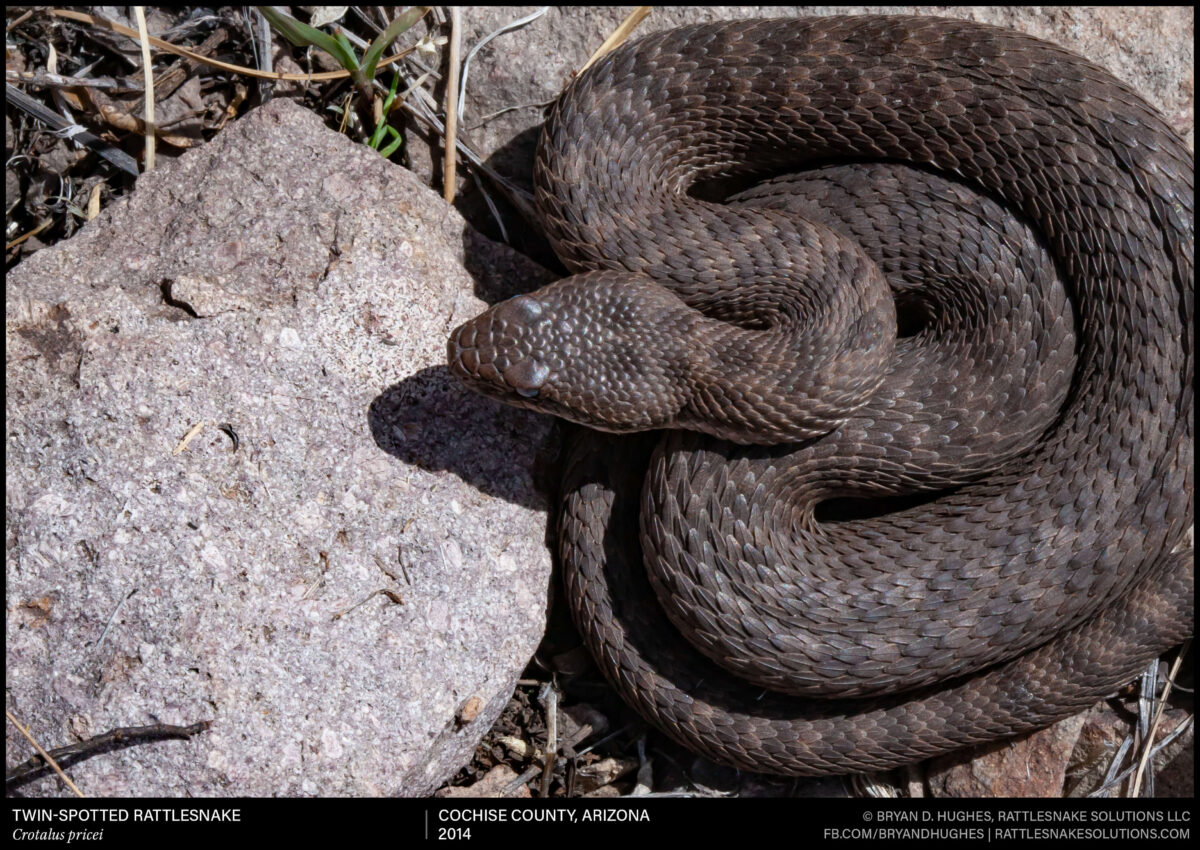
A Twin-Spotted Rattlesnake with a relatively drab pattern, but not atypical for an older adult. These are small snakes, rarely seen by hikers, as their range within the U.S. consists of only a handful of mountains in southeastern Arizona. In addition to rodents, these rattlesnakes also specialize in lizards, often taking the colorful Yarrows Spiny Lizards also common to rocky outcrops in high pine forests. These are among the protected species within Arizona, but a good number of them still end up being taken from the mountains each year to enter the European black market.
Prival, D. B., Goode, M. J., Swann, D. E., & Schwalbe, C. R. (2002). Natural history of a northern population of twin-spotted rattlesnakes, Crotalus pricei. Journal of Herpetology, 36(4), 598–607. https://doi.org/10.1670/0022-1511(2002)036[0598:NHOANP]2.0.CO;2
Prival, D. B., & Schroff, M. J. (2012). A 13-year study of a northern population of twin-spotted rattlesnakes (Crotalus pricei): Growth, reproduction, survival, and conservation. Herpetological Monographs, 26(1), 1–18. https://doi.org/10.1655/HERPMONOGRAPHS-D-11-00002.1
Prival, D. B., Goode, M. J., Swann, D. E., & Schwalbe, C. R. (1999). A comparative study of hunted vs. unhunted populations of the twin-spotted rattlesnake. Unpublished report, University of Arizona. PDF link
Grabowsky, E. R., & Mackessy, S. P. (2019). Predator-prey interactions and venom composition in a high elevation lizard specialist, Crotalus pricei (Twin-spotted Rattlesnake). Toxicon, 170, 88–97. https://doi.org/10.1016/j.toxicon.2019.09.003
Grabowsky, E. (2018). Venom composition of little known mountain rattlesnakes and predator-prey interactions of Crotalus pricei pricei and its natural prey, Sceloporus jarrovii (Master’s thesis). University of Northern Colorado. https://digscholarship.unco.edu/theses/251/
Bezy, R. L. (2021). Biogeographic outliers in the Arizona herpetofauna. Sonoran Herpetologist, 34(2), 45–58. PDF
Pough, F. H. (1966). Ecological relationships of rattlesnakes in southeastern Arizona with notes on other species. Copeia, 1966(4), 649–658. https://doi.org/10.2307/1441401
Bezy, R. L., & Cole, C. J. (2014). Amphibians and reptiles of the Madrean Archipelago of Arizona and New Mexico. American Museum Novitates, 2014(3810), 1–24. https://doi.org/10.1206/3810.1
Kauffeld, C. F. (1943). Field notes on some Arizona reptiles and amphibians. The American Midland Naturalist, 29(2), 342–359. https://doi.org/10.2307/2420795
Gloyd, H. K. (1937). A herpetological consideration of faunal areas in southern Arizona. Bulletin of the Chicago Academy of Sciences, 5(6), 79–136.