Western Diamondback Rattlesnake Warning

A Western Diamondback Rattlesnake communicating with me in the same way it does with any of the many predators that it fears. He stands up as tall as he can, hissing, rattling, and making the idea of coming any closer a decidedly bad idea.

What it isn’t doing: showing aggression. This behavior, even though it may seem scary (as it is intended to), is not a sign of “attack”, but a small animal’s best attempt at preserving its own life. For some reason, humans have a very hard time understanding this, and the incredibly simple way for everyone to leave safely: walk away. After a few photos, that’s what I did. Thanks for the heads up, snake.

Arizona Ridgenosed Rattlesnake

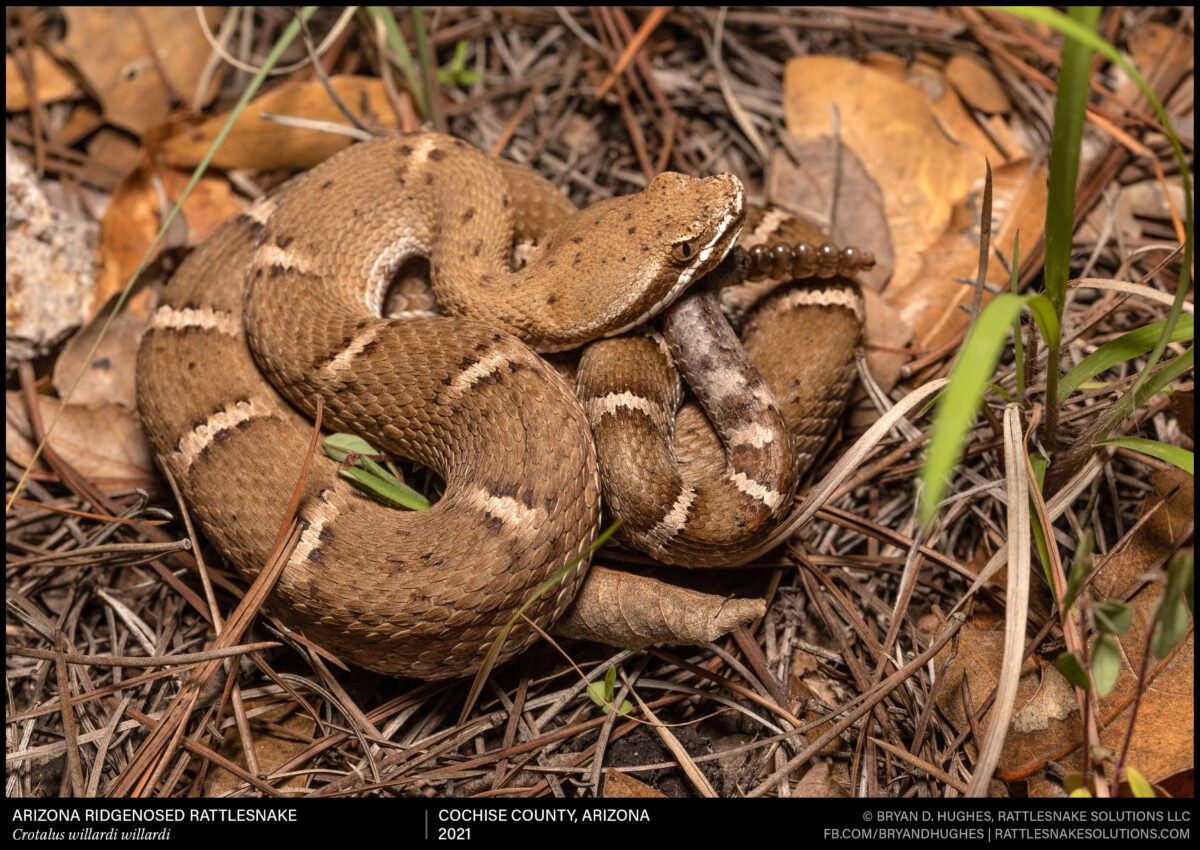
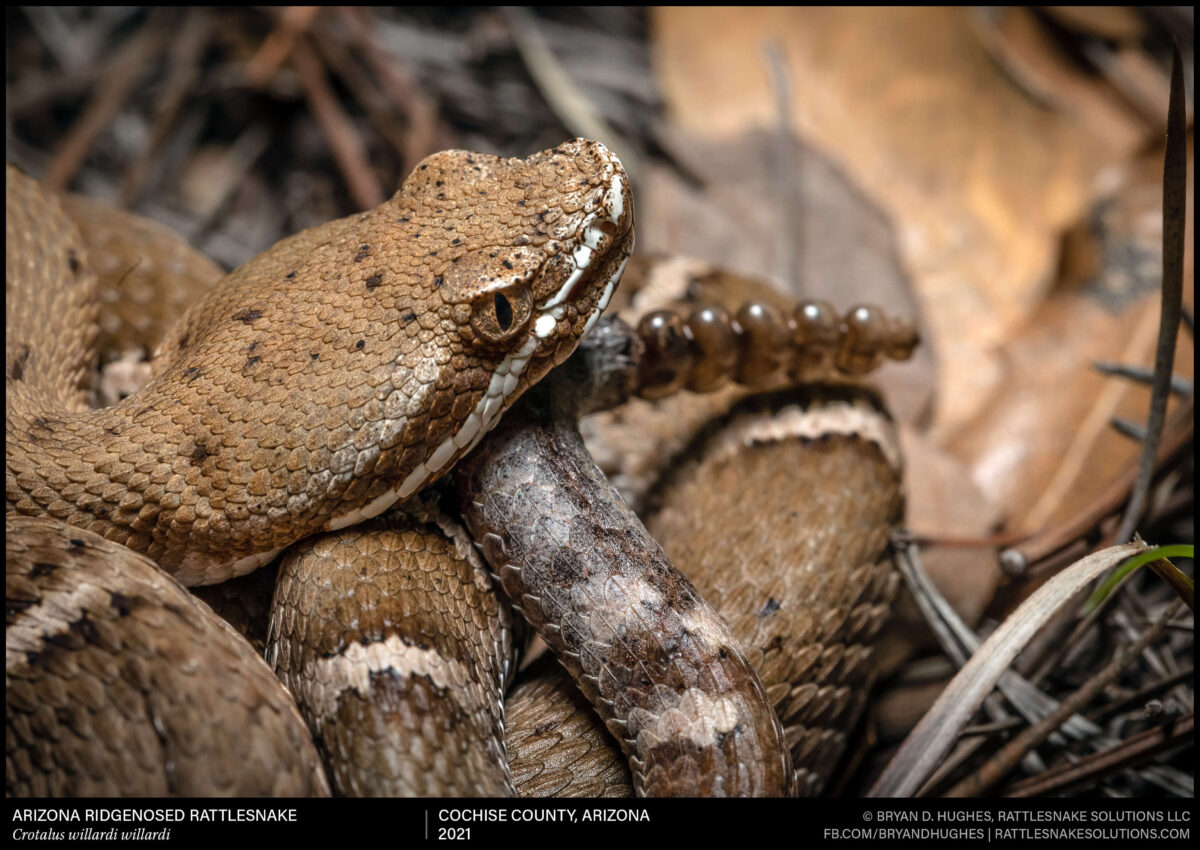
An Arizona Ridgenosed Rattlesnake from the southeastern corner of Arizona. I photographed this young snake back in 2014 (that’s how behind I am in photos).

At this point, assuming she hasn’t met an end by fire, drought, bear, poacher, or any of the other ways a small snake can enter the carbon cycle, she is an older adult. She may have given birth every couple or few years, and still has a lot of life to live. Rattlesnakes can live for decades, continually learning to make better use of their environment and home range.

Speckled Rattlesnake At Dawn and Thermal Tolerances

A Southwestern Speckled Rattlesnake resting along the top of a drainage after a night out. During the summer months, these and other rattlesnake species are primarily nocturnal, being encountered by people mostly in the hour before and after sunrise. As soon as the sun reaches the area, these snakes make a beeline for their aestivation sites to hide for the day.

The fact that rattlesnakes are often nocturnal and that they spend much of their lives avoiding excess heat is a surprise to many people. The misconception is that reptiles, ectotherms who get heat from the environment rather than produce it themselves, want it hot … the hotter the better. You’ll see this soon, in the form of comments like “it’s getting hot! It brings the rattlers out”, warnings from fire departments, and even articles in local news when temperatures stabilize in the triple digits for the year.

But thermoregulation means being the right temperature, not just as hot as possible. In fact, a body temperature sustained above around 105˚F can kill a rattlesnake. Interestingly, the upper terminal temperature seems to be similar across rattlesnake species, regardless of the environment they’re found. It’s often over 100˚F when these snakes begin their move back to their underground hiding spots, meaning they ride the line of death very closely, staying out as long as possible for the chance to find prey. If they are disturbed during this crawl for too long, or escape into the wrong hiding spot, it can quickly kill them.

We have learned this first-hand, unfortunately, from finding snakes within our study area who were first found by snake enthusiasts, likely mid-crawl. Thanks to Instagram, individual snakes that had died this way can be tied to individual events where a prolonged photo session and subsequent release of a heat-stressed snake resulted in death. To some herpers, it may seem like gatekeeping to discuss this kind of thing, but dead snakes are a lesson to those who would hear it.

During the summer, you may see us be critical of snake relocations performed by the fire department, and well-meaning individuals. This comes from the practice of releasing these snakes to improper cover, where they will be very unlikely to find survivable conditions in time. Every time you see a video of someone releasing a snake to open ground or random creosote mid-day, the relocator watches it crawl away and may be satisfied that they helped the animal … but these snakes do not survive for long.

Claunch, N. M., Lind, C. M., Lutterschmidt, D. I. (2023). Stress ecology in snakes. In Penning, D. A. (Ed.), The Stress Ecology of Reptiles. ResearchGate.

https://www.researchgate.net/publication/372807259_Stress_Ecology_in_Snakes

Cadena, V., Andrade, D. V., Bovo, R. P., Tattersall, G. J. (2013). Evaporative respiratory cooling augments pit organ thermal detection in rattlesnakes. Journal of Comparative Physiology A, 199(9), 883–893.

https://doi.org/10.1007/s00359-013-0852-4

Castro, S. A., Prado, J. V., Wang, T. (2024). The relevance of vascular adjustments to hemodynamic control in the face of temperature change in Crotalus durissus. Journal of Experimental Biology, 227(15).

https://journals.biologists.com/jeb/article/227/15/jeb247724/361626

Laursen, W. J., Anderson, E. O., Hoffstaetter, L. J., Bagriantsev, S. N., & Gracheva, E. O. (2015). Species-specific temperature sensitivity of TRPA1. Temperature, 2(1), 142–157.

https://doi.org/10.1080/23328940.2014.1000702

Kamees, L. K. (2022). Competing Behaviors of Thermoregulation and Ambush Foraging in the Timber Rattlesnake (Crotalus horridus horridus): A Mechanistic Assessment of Thermal Behavior (Doctoral dissertation, University of Arkansas).

https://scholarworks.uark.edu/etd/5172

Tattersall, G. J., Sinclair, B. J., Withers, P. C., Fields, P. A., Seebacher, F., Cooper, C. E., & Maloney, S. K. (2012). Coping with thermal challenges: physiological adaptations to environmental temperatures. In Comprehensive Physiology, Wiley.

LaDuc, T. J., Borrell, B. J., & Dudley, R. (2005). Respiratory cooling in rattlesnakes. Comparative Biochemistry and Physiology Part A, 141(4), 509–516.

https://doi.org/10.1016/j.cbpb.2005.04.010

Carnes-Mason, M. D., & Beaupre, S. J. (2025). Temperature manipulation induces ecdysis in lab-held rattlesnakes. Ichthyology & Herpetology, 113(2), 274–281.

https://www.researchgate.net/publication/391371436

Gila Monster In A Burn Scar

A Gila Monster moving through a burn scar in central Arizona. Last year, fire from an illegal campfire swept through the area, fueled by invasive grasses. This one managed to survive, but shows signs of how close it came to death – the top of its head and patches on its tail are black scars.

Wildfires like this are now common, as fires, OHV use, and target shooting spark them constantly. With hotter, drier years, and increased human activity in the area, another fire is likely as soon as there’s enough regrowth to burn. The landscape in another decade will be unrecognizable, without saguaro, native trees, and erosion erasing the rocky arroyos where the only surface water was available.

If your first reaction is to deny human involvement in all of this, a better use of time would be to stop watching political messaging and start looking out your own window.

Barra, C., Fule, M., Beers, R., McGuire, L., & Youberg, A. (2025). Soil biogeochemical and hydraulic property response to wildfire across forested ecosystems of the Santa Catalina Mountains, Arizona, USA. CATENA. Elsevier.

https://www.sciencedirect.com/science/article/pii/S0341816225001043

Boyle, J. M. (2025). Spatial and temporal trends of reburns in western US forests (Undergraduate thesis, Gettysburg College). Cupola: Scholarship at Gettysburg College.

https://cupola.gettysburg.edu/student_scholarship/1153

Jiménez Morillo, N. T., Rosa Arranz, J. M., & Miller, A. Z. (2024). Soil degradation: Local solutions for a global problem. CSIC Digital Repository.

https://digital.csic.es/handle/10261/383118

Banded Rock Rattlesnakes Courting Under A Rock

A mated pair of Banded Rock Rattlesnakes, tucked into rocks in a minor drainage in southeastern Arizona. During the late monsoon season, it’s not uncommon to find pairs or rattlesnakes like this, courting and mating in one rock pile while others are still giving birth elsewhere. The period of seasonal rain is the peak of activity for these animals, and a lot needs to be done in a relatively short period of time.

1.  Mata-Silva, V. (2011). Ecology of the Rock Rattlesnake (Crotalus lepidus) in the Northern Chihuahuan Desert. University of Texas at El Paso.
2. Mata-Silva, V., DeSantis, D.L., Wagler, A.E., et al. (2018). Spatial Ecology of Rock Rattlesnakes (Crotalus lepidus) in Far West Texas. Herpetologica, 74(3), 245–255.
https://doi.org/10.1655/Herpetologica-D-17-00091.1