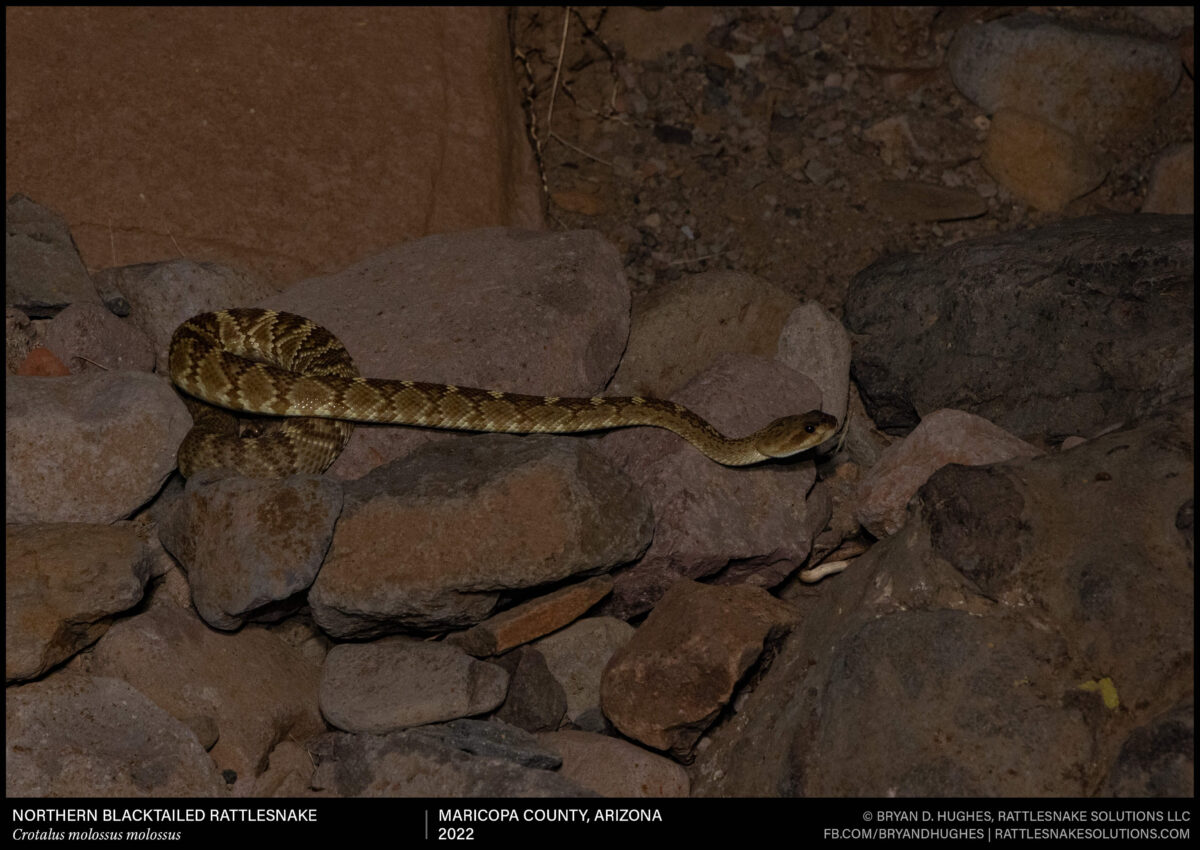
A young Blacktailed Rattlesnake breaking position to hide in rocks. We’d accidentally disturbed it by showing up, but it held this pose long enough for us to back off and get a few photos. This is in a remote canyon far from any road, and being bothered by people isn’t a regular thing for the snakes here.
A colorful Banded Rock Rattlesnake from southeastern Arizona. These small rattlesnakes, when encountered, almost always quickly flee. This may be accompanied by a high pitched rattle that could easily be ignored as a cicada, or not heard at all.
An interesting note on these snakes: of all of the ranchers, hunters, and cabin owners I’ve talked to in the field over the years, none of them have heard of this snake. Despite being exceedingly common in the right habitat, they’re apparently easy to miss or at least mistake as something else.
A Great Basin Rattlesnake from northern Arizona, showing off its sharply patterned face. These are a wide-spread rattlesnake species, found throughout the Great Basin Desert in the western US, and some transitional habitat with influence from Mohave and Sonoran deserts, and high-elevation pine forest. Personally, I think the rosy-cheeked variety often seen in the Arizona Strip are uniquely beautiful. This one was photographed and left alone to continue doing its rattlesnakey things.
A dull Arizona Ridgenosed Rattlesnake found out at night in madrean oak forest of southeastern Arizona. Nocturnal activity is common with this species during the humid, hot nights of monsoon season.
A young Blacktailed Rattlesnake moving up from the rock wall where it lives to catch morning sun in southeastern Arizona. Structures like this provide a range of options, allowing the snake to very precisely control its temperature – warming when it needs to, and retreating to shade as the day gets hot.
A Speckled Rattlesnake from the Belmont Mountains, west of Phoenix. These rattlesnakes in this range often lack much of the characteristic speckling within the eye, leaving solid-colored, light grey or pale white eyes. A typical response when we post a snake from this area is something like “it’s ready to shed skin”, though that is not at all the case.
Just before sunset, we found a Great Basin Rattlesnake crossing a road in northeastern Arizona. It was bothered for a few minutes while we took some photos.
A Southwestern Speckled Rattlesnake looking just like a chunk of granite, fallen off the overhead outcrop. As the sun gets lower in the sky, a variety of rodents, birds, and lizards do what they do in surrounding bushes and rocks, oblivious to the invisible predator. To hikers on the mountain, they’re often just as cryptic, remaining hidden as hundreds of feet pass by every Saturday on popular trails.
I first saw the diagonal parallel track lines in the sand, and stopped the car to take look for who left them. Nearby, the track-owner was on the move: a male Sonoran Sidewinder (right). I recognized its behavior as tracking something … maybe food, a mate, etc. His head moved side to side, tongue flicking fast and touching the ground.
Maybe 20 seconds later – I saw what he was looking for, a larger, female Sonoran Sidewinder. She continued sidewinding out of the area, with him following close behind. She eventually settled under a bush, and his courting eventually paid off. They were still there mating hours later on the return trip.
Notable here: the male went in and out of the standard sidewinding motion and rectilinear (straight, belly crawl) movement when tracking. Sidewinding was again used to move more quickly and keep up with the female when she was on her way.