If you don’t want rattlesnakes on the property, you need to control food, shelter, and access. That can be a challenge with the varieity of rodents living nearby. But, there’s a lot you can do to permanently remove rodent burrow networks WITHOUT paying for it, using traps, or poison.
Here’s what I do at my own property to keep rodents and rattlesnakes away from my office.
Step 1: Use a garden hose to flood the hole. Use low pressure, maybe just a quarter turn, to avoid collapsing the entrance of the burrow
Step 2: Let it fill slowly from the bottom up. When it fills, let it settle, then repeat as necessary until water it is entirely full.
Step 3: Kick in (or use a shovel) the entrance. That’s it!
By doing this, anything living in there is forced to leave. Not only that, but the entire network, including all those dry, warm spaces where rodents were using, are destroyed.
Rip Rap, Erosion Control, and Accidental Rattlesnake Dens
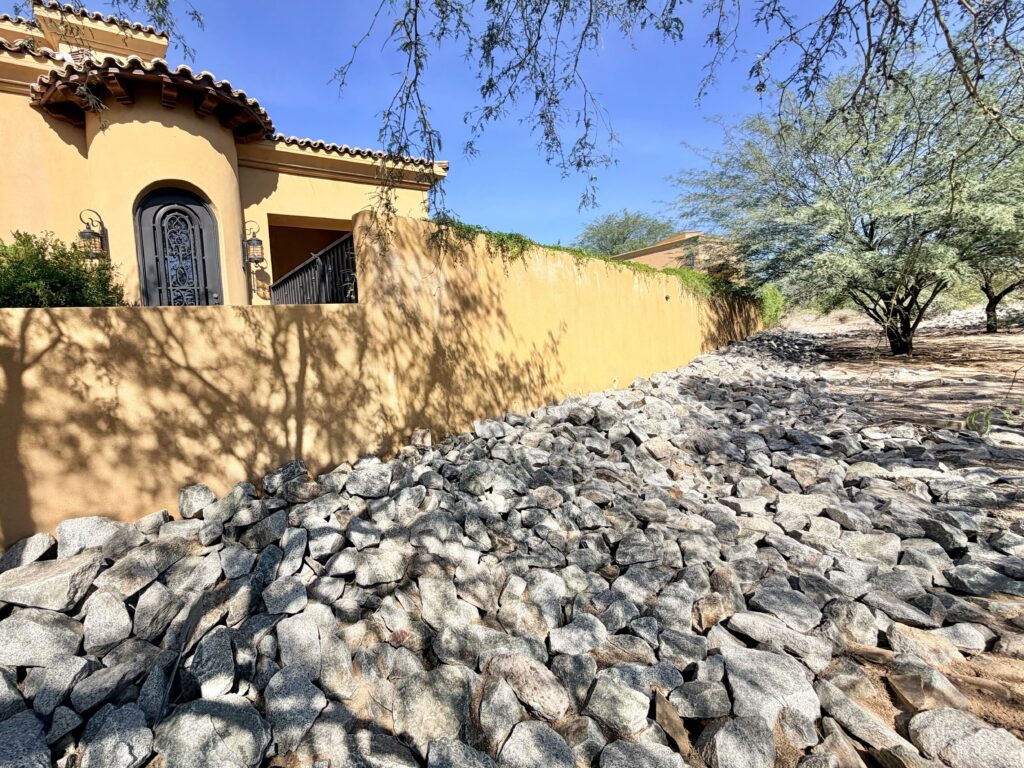
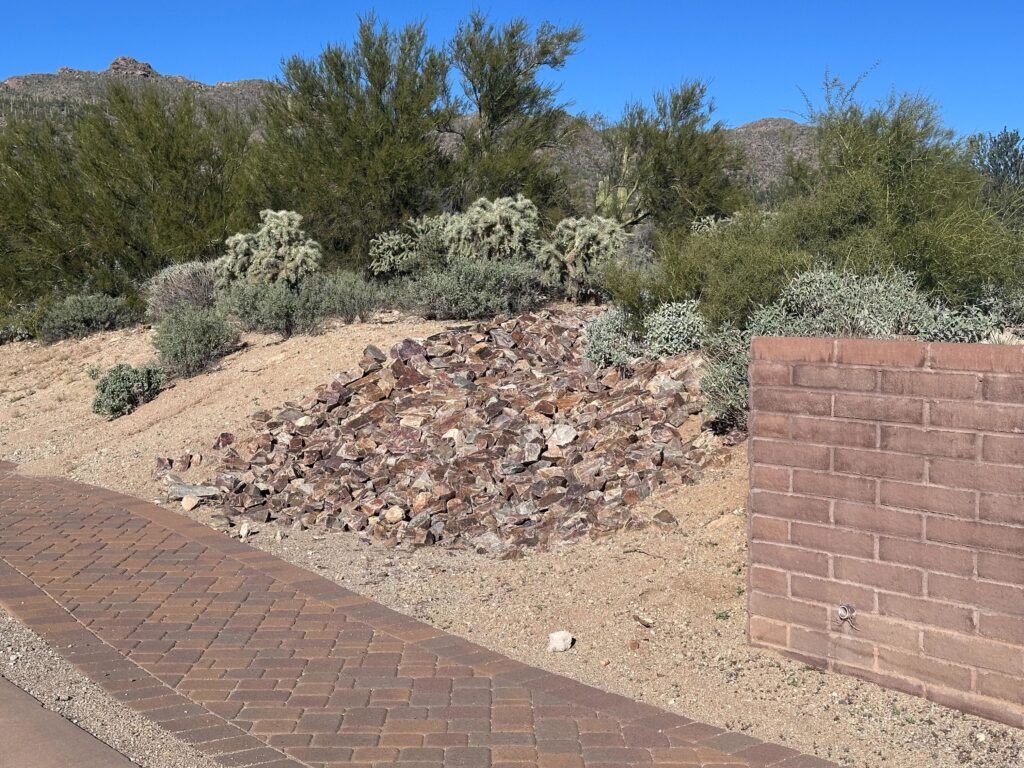
Rip rap solves erosion problems. It also solves rattlesnakes’ housing problems very efficiently. When you stack large rock several layers deep along a wash or slope, you are often building prime den and foraging habitat for Western Diamondback Rattlesnakes and a lot of other wildlife.
From thousands of relocations at homes along desert washes and engineered channels, we see the same pattern over and over: deep, irregular rock plus rodents and vegetation equals snakes.
This article explains why that happens, how it relates to what we know about rattlesnake behavior and thermoregulation, and what you can do about it if you need riprap on your property.
Why Rip Rap Works So Well As Rattlesnake Habitat
Structure: Cavities, Stability, and Protection
Rattlesnakes like Western Diamondbacks naturally use rocky slopes, fractured bedrock, and rodent burrows. They are looking for stable, tight spaces where temperature and humidity are more predictable than the surface.
Rip rap replicates all of that in a very concentrated way:
Rock piles, manmade or otherwise, can act like a thermostat, allowing cold-blooded creatures to finely tune their temperature by taking advantage of conductive heat retention
Multiple rock layers create deep voids and tunnels that are protected from predators, people, and extreme surface temperatures.
Irregular rock sizes leave numerous interconnected cavities. Snakes can move vertically and horizontally without being seen.
Contact with soil and concrete helps buffer temperature swings and hold some moisture.
In other words, a deep rip rap face behaves like a man-made talus slope. From the snake’s perspective, it is a ready-made den system dropped right into the middle of its range. Especially in the absence of other suitable habitat, whether it was never there or was removed during development of the area, this is essential habitat for snakes.
Conductively Stable Rock: Why Big Boulders Matter
“Conductively stable” sounds technical, but the idea is simple. Larger rocks take longer to heat and longer to cool. Smaller rocks heat and cool quickly.
For a rattlesnake, that matters:
Big, dense boulders and concrete hold heat into the night.
The spaces under and between them stay closer to a target body temperature than the open air.
Deeper layers change temperature more slowly than the surface, so they make good winter refuges.
When you combine large boulders with depth and contact with the ground or a wall, you create a huge volume of rock that changes temperature slowly and predictably. That is exactly what snakes want in a den.
If the same slope were covered in a single layer of softball-sized rock, with very little depth or variation, there would still be the occasional hiding spot, but almost none of the buffered, multi-level thermal structure that makes a real den.
Thermoregulation: How Western Diamondbacks Use Rock Piles
Western Diamondbacks are ectotherms. Their body temperature is set by the environment, so they survive by moving between warmer and cooler spots instead of burning calories to generate heat.
Field and lab work on Crotalus atrox line up almost perfectly with what we see in rip rap:
They prefer a relatively narrow range of body temperatures to keep digestion, immune function, and movement efficient.
They frequently shuttle between microhabitats, using sun, partial cover, and shade to fine tune body temperature.
They can use their facial heat-sensing pits not just for hunting, but to select retreat sites based on thermal radiation, even in complex environments.
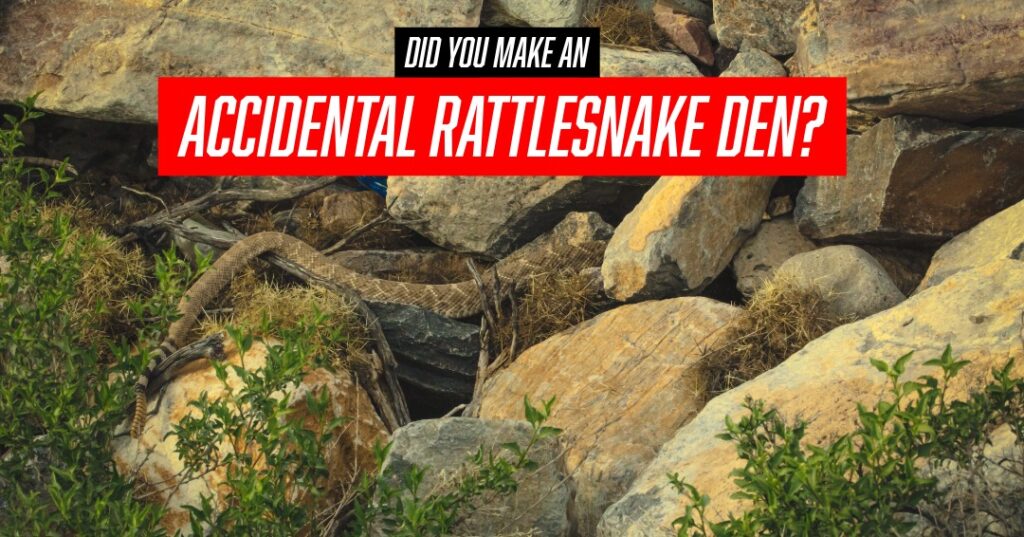
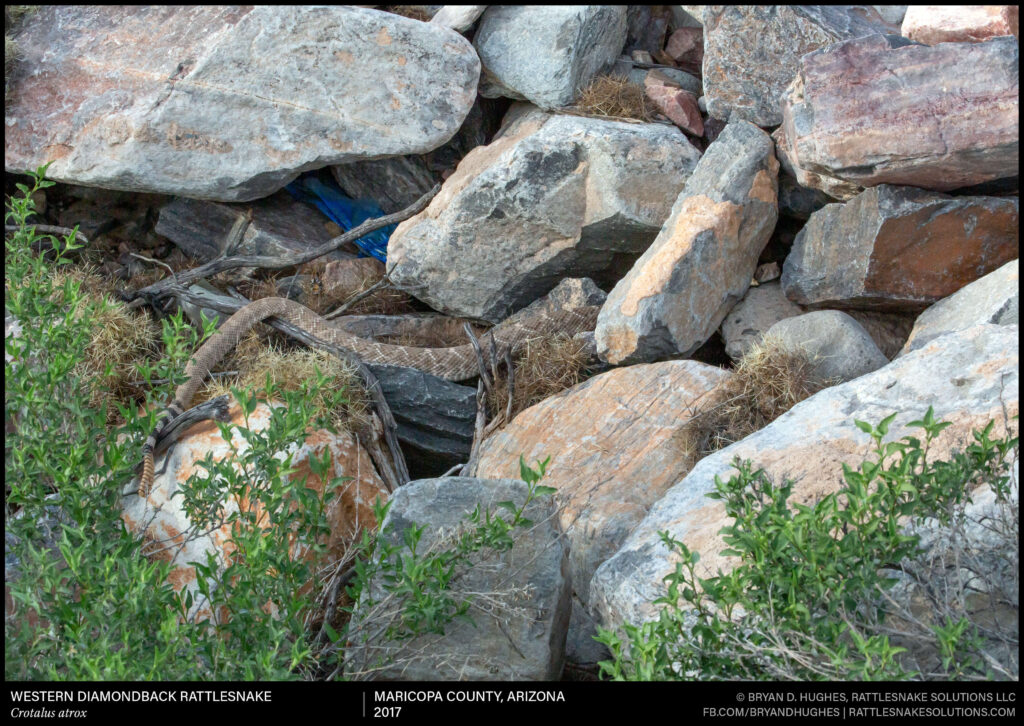
A Western Diamondback Rattlesnake hanging out at an old rock pile left during construction of a road. This area has many rattlesnakes, all there for the reasons described in this article.
So in a big rip rap installation, a snake can do all of this without ever being exposed for long:
Basking at the surface in morning sun.
Sliding back a few rocks into filtered light.
Dropping deeper into the pile as the day heats up.
In winter, staying far inside the structure where temperatures are stable and above lethal limits.
Experimental work has shown Western Diamondbacks can actively choose thermally favorable retreats even when the choices are subtle and spread out in space. A multi-layer rock pile gives them dozens of options within a few body lengths.
Denning Behavior and Rip Rap
In Arizona, Western Diamondbacks and other rattlesnakes spend winter in dens, often shared by multiple individuals. Natural dens are usually:
Rocky slopes, fractured bedrock, cliffs, or deep crevices.
Rodent burrow systems with enough depth and structure.
Root systems and voids near large rocks or human structures.
From thousands of winter calls, it is clear that many “homes as dens” situations happen where human structures mimic that same recipe: retaining walls, shaded foundations, and deep rock features near block walls or slabs.
Deep rip rap along the edge of a property, especially when:
It is shaded by walls, trees, or buildings.
It ties into culverts, foundations, or bridge abutments.
It is near natural desert or a wash, is effectively a ready-made communal den that will be discovered and used sooner or later.
Lessons From Residential Work in Arizona
From the prevention side of Rattlesnake Solutions, a few things are very consistent on properties with rip rap:
Heavy, deep rip rap near use areas Deep rock right against patios, pool decks, and play areas is where we see most conflicts. If a snake can den within a few feet of where people walk every day, you are going to see it sooner or later.
Rock tied directly to desert or open wash When rip rap is continuous with natural desert or a major drainage, it acts as a highway for wildlife. Snakes simply follow the channel and end up right next to houses.
Brush and yard clutter within a few feet of the rock Brush piles, stacked lumber, stored block, and unmaintained shrub beds at the edge of rip rap create a “soft edge” that snakes can use to stage before moving out into yards.
No barrier between rock and the yard Where there is no properly installed snake fence between deep rip rap and high-use areas, we see repeat encounters in the same spots year after year.
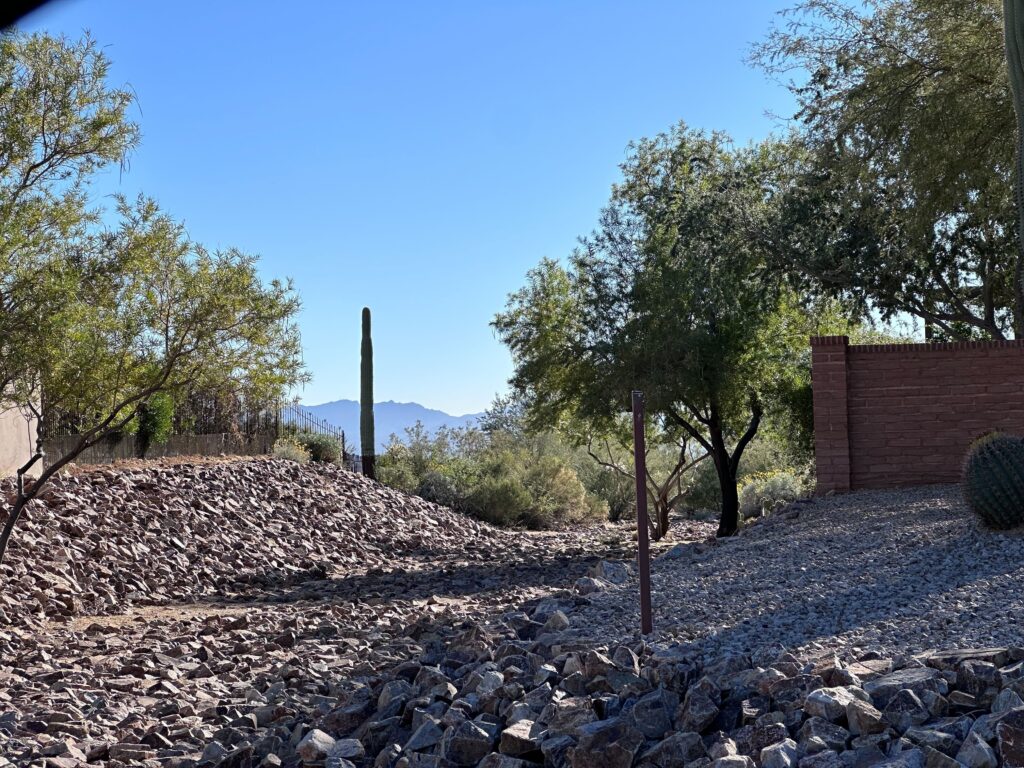
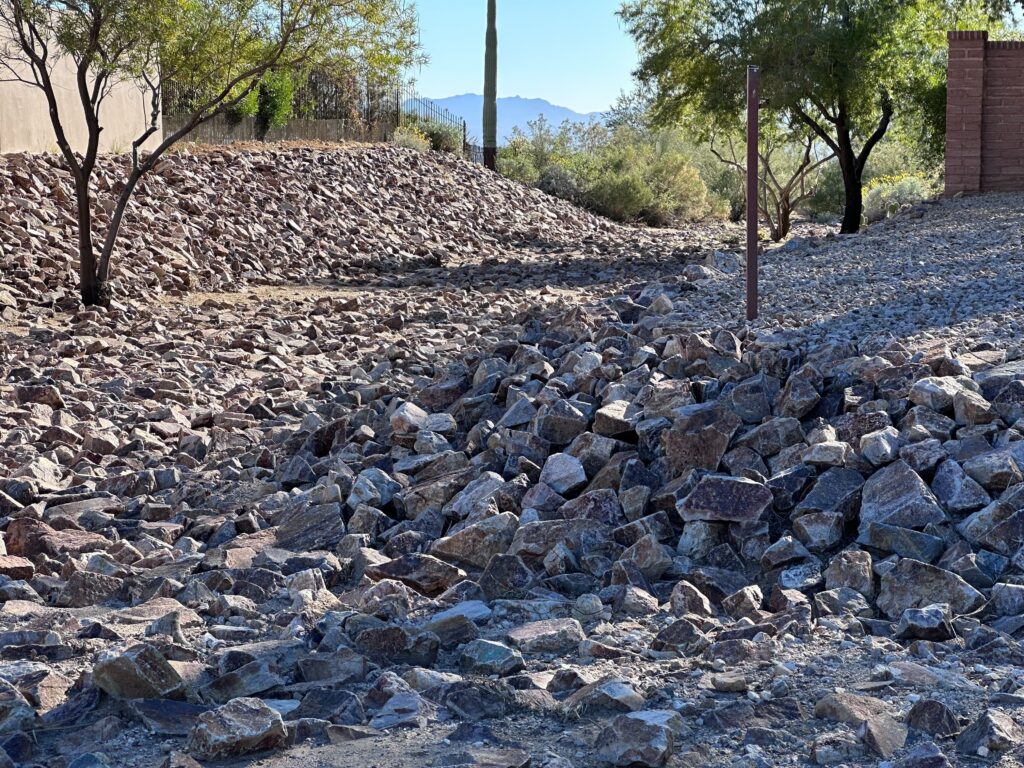
This is, basically, rattlesnake heaven. Courtesy of the developers of this community 😉
Practical Design Guidelines for Engineers, HOAs, and Contractors
You are not going to avoid rip rap in a lot of Arizona developments. Water still wins. But you can choose whether those installations are high-quality rattlesnake habitat or just functional rock.
Here are practical guidelines that line up with both engineering needs and wildlife behavior.
1. Limit Depth Where You Can
Use only the minimum depth necessary for erosion control, especially near structures and high-use areas.
Where hydraulic requirements allow, keep riprap to a single rock layer rather than several layers deep.
Transition to compacted soil, stabilized banks, or other treatments as soon as possible upstream and downstream.
2. Control Rock Size and Uniformity
Near homes and paths, favor smaller, more uniform rock rather than a wide mix with large boulders.
Avoid rocks larger than about cantaloupe size close to structures. Larger blocks belong in the deepest, most inaccessible sections of the channel.
This reduces the range of thermal options and eliminates many of the deeper voids that make good overwintering sites.
3. Separate Rip Rap From Living Space
Do not run deep rip rap right up against fences, patios, or play areas if it can be avoided.
Use flat transitions, low retaining walls, or other hardscape between the rock and yard to break up habitat continuity.
Where deep rip rap must sit right against a property line, consider proper rattlesnake fencing around the adjacent yard to intercept movement.
What Homeowners Next to Rip Rap Can Actually Do
If you already live next to a big rip rap installation, you are not getting it removed. You can still reduce how often rattlesnakes show up in your actual living space.
Around the yard
Maintain a 4 to 6 foot buffer of open ground or short, sparse plants between the rip rap and the rest of the yard.
Get rid of junk piles, unused pavers, and long-term storage along the rock edge.
Keep grass cut short near the rock.
Be realistic about bird feeders. If you want fewer snakes, do not concentrate rodents right next to a perfect snake den.
At the property boundary
If deep rip rap touches your wall or view fence, a properly installed rattlesnake fence can physically separate the den habitat from where kids and pets spend time.
Seasonal behavior
Expect more visible activity in spring and fall, when snakes are shifting between warm-season foraging grounds and winter den sites.
In winter, assume that deep rip rap near walls and structures may be housing overwintering snakes even when you are not seeing them.
Key Takeaways
Deep, mixed-size rip rap with big boulders behaves like a natural talus slope and often becomes a rattlesnake den.
Western Diamondbacks actively use fine-scale thermal differences in rock piles to regulate body temperature, and rip rap provides many such options in a small area.
Rodent activity, brush, and human attractants around rip rap greatly increase the odds that snakes will move between the rock and a yard.
Design choices about rock depth, size, and placement, plus simple landscaping and fencing decisions, can dramatically reduce how often rattlesnakes end up where people live.
Selected References on Den Use and Thermoregulation in Western Diamondbacks
Beck, D. D. 1995. Ecology and energetics of three sympatric rattlesnake species in the Sonoran Desert. Journal of Herpetology 29(2): 211–223.
Krochmal, A. R., and G. S. Bakken. 2003. Thermoregulation is the pits: Use of thermal radiation for retreat site selection by rattlesnakes. Journal of Experimental Biology 206: 2539–2545.
Da Cunha, O. 2024. Trade-offs between thermoregulation and crypsis in the Western Diamond-backed Rattlesnake (Crotalus atrox). Doctoral dissertation, University of Texas at El Paso.
White, F. N., Lasiewski R. C. 1971. Rattlesnake denning: Theoretical considerations on winter survival. Journal of Comparative Physiology 73: 349–356.
This guide is a Phoenix metro resident’s go-to for identifying snakes in everyday places: your backyard, a trail, or even indoors. It gets right to the point: What is it? Is it dangerous? What should be done … or can I just ignore it?
This isn’t your average field guide, drawing on data from thousands of snake relocations over more than 20 years, encounters from homeowners and hikers, and researchers’ first-hand observations. We’ve tailored the information to reflect real-life comments and questions from people just like you, focusing on situations and species that are most relevant to everyday life.
For instance, we discuss Shovelnosed Snakes and Coralsnakes side-by-side, not because of scientific classification, but because it’s a practical pairwise comparison. Similarly, the rarely-seen Glossysnake is reserved for latter pages, despite its resemblance to the more commonly seen Sonoran Gophersnake. We don’t list the world record size; we give the biggest that people may actually see.
Some illustrations are adjusted to highlight key identification features, making it easier to identify an animal without counting scales or getting too close. This guide is designed to be a practical, easy-to-use tool for all who may encounter snakes, regardless of whether they like them.
Each species and topic includes a QR code to go to more information, which will continue to expand over time. The goal: someone may see an unknown snake on a path and just want to know what it is, but has access down the rabbit hole to depth of information on its natural history, photographs, videos, and much more.
Snakes are arranged in the book in order based on appearance and likelihood to encounter, visual similarity, and other observer-oriented factors, rather than taxonomic similarity.
How to get it?
The best part: we are distributing it for free. As these cost more to print than a simple flyer, our plan is to offer it to the community as a self-sustaining resource. Here’s the plan:
A simple advertisement for our Rattlesnake Fencing system as the last page of the booklet
Offered for sale online, at a price that covers postage, printing, and taxes
Offered for free at presentations and events, with a donation box that will go entirely to printing the next run
Given free to all new rattlesnake fence consultation clients
Given free to many* snake relocation clients (we have some distribution details to sort out)
Available for pick-up at some local businesses, TBD (if you want to be one of these businesses, email bryan@rattlesnakesolutions.com)
Available for pickup at:
Local Jonny’s Tavern & Cafe 6033 E Cave Creek Rd, Cave Creek, AZ 85331
With an initial run of just 3000 copies, we will order a larger run as soon as funds are generated to match the print and shipping costs, and do the same.