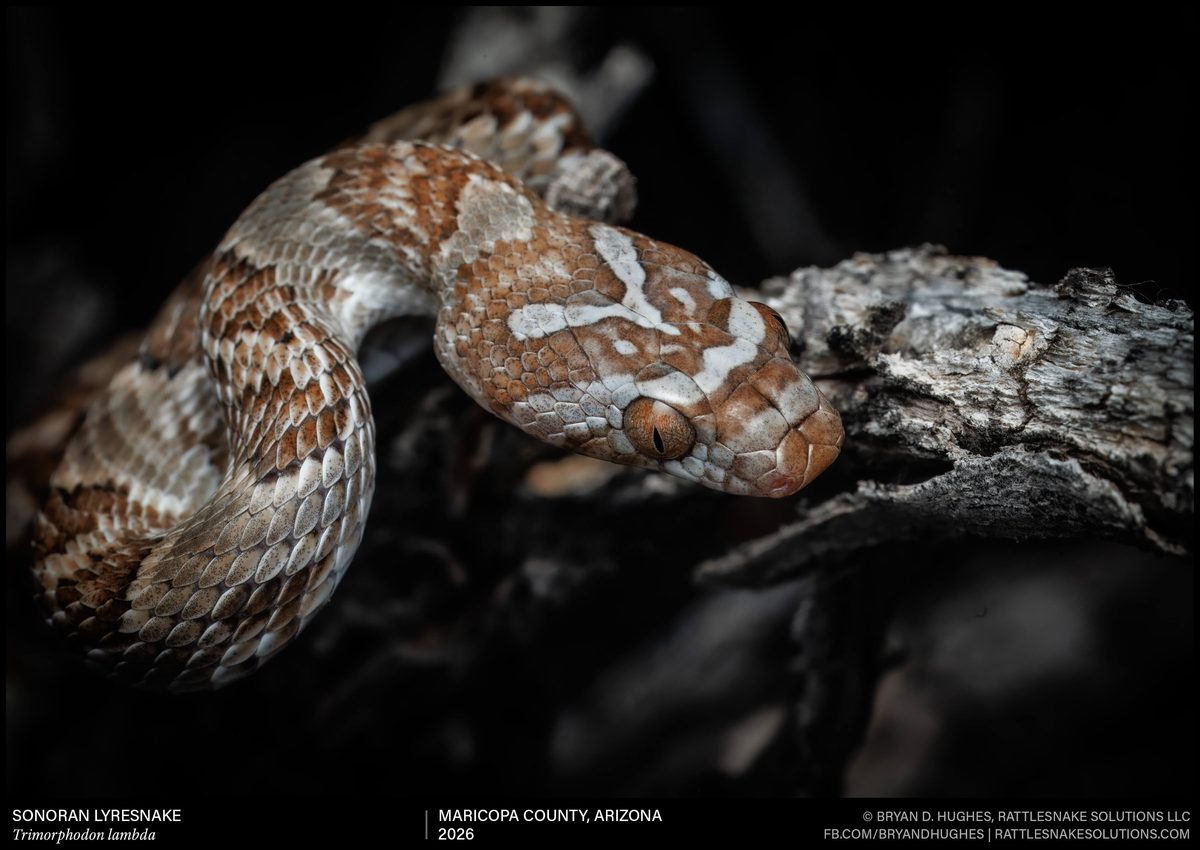
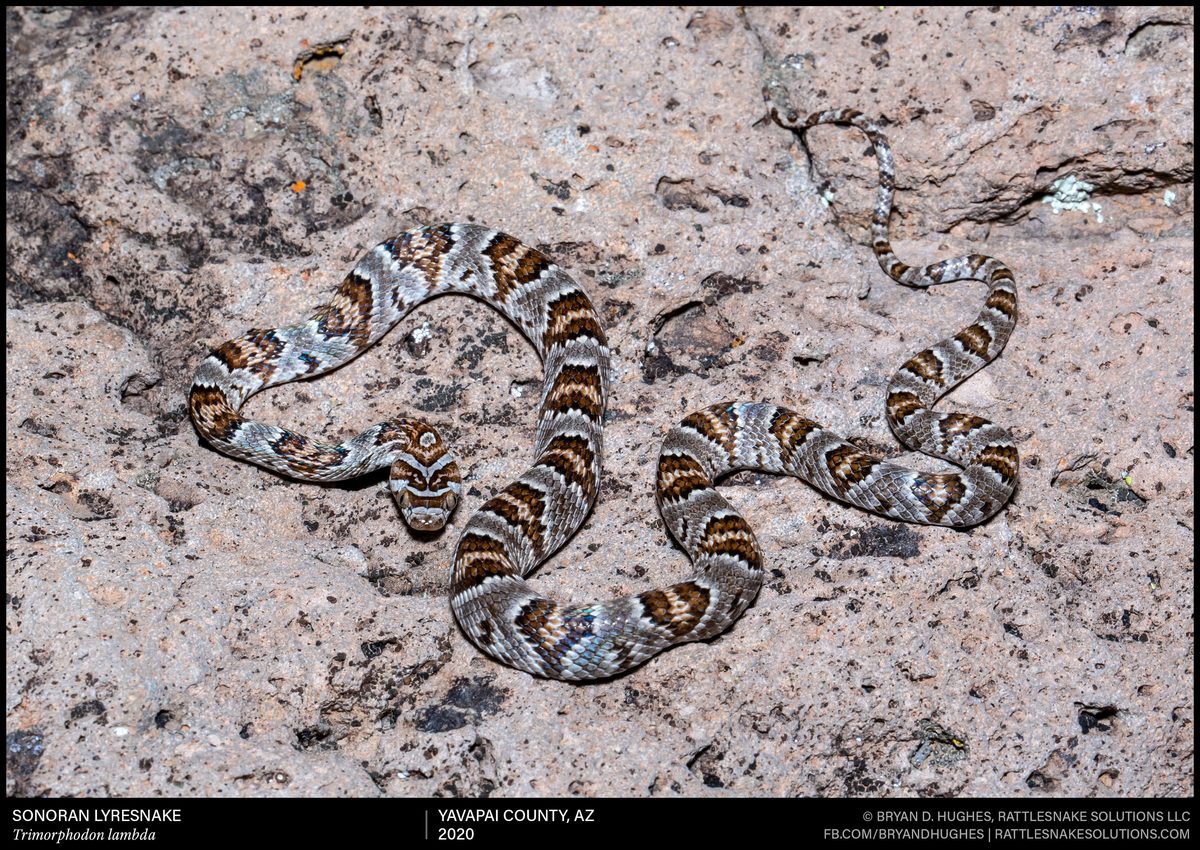
We found this Sonoran Lyresnake on the move on a night hike in Yavapai County sevearl years back. This one is typical of the species for the area, with chaotic brown and tan blotches over a beige body, with a relatively disoganized look compared to some of the more cleanly banded version found elsewhere. They’re slightly venomous, feeding on lizards, rodents, and bats. It’s not harmful to humans, but I still avoid a bite like I would from any snake.
Devitt, T. J. (2006). Phylogeography of the Western Lyresnake (Trimorphodon biscutatus): Testing aridland biogeographical hypotheses across the Nearctic–Neotropical transition. Molecular Ecology, 15, 4387–4407. https://doi.org/10.1111/j.1365-294X.2006.03015.x
Mackessy, S. P., & Saviola, A. J. (2016). Understanding biological roles of venoms among the Caenophidia: The importance of rear-fanged snakes. Integrative and Comparative Biology, 56(5), 1004–1012. https://academic.oup.com/icb/article/56/5/1004/2420638