A young Sonoran Sidewinder (Crotalus cerastes cercobombus) with a nice, clean pattern near Phoenix last year. These small rattlesnakes are very common in the right habitat, but rarely seen by hikers because of the nature of that same habitat.
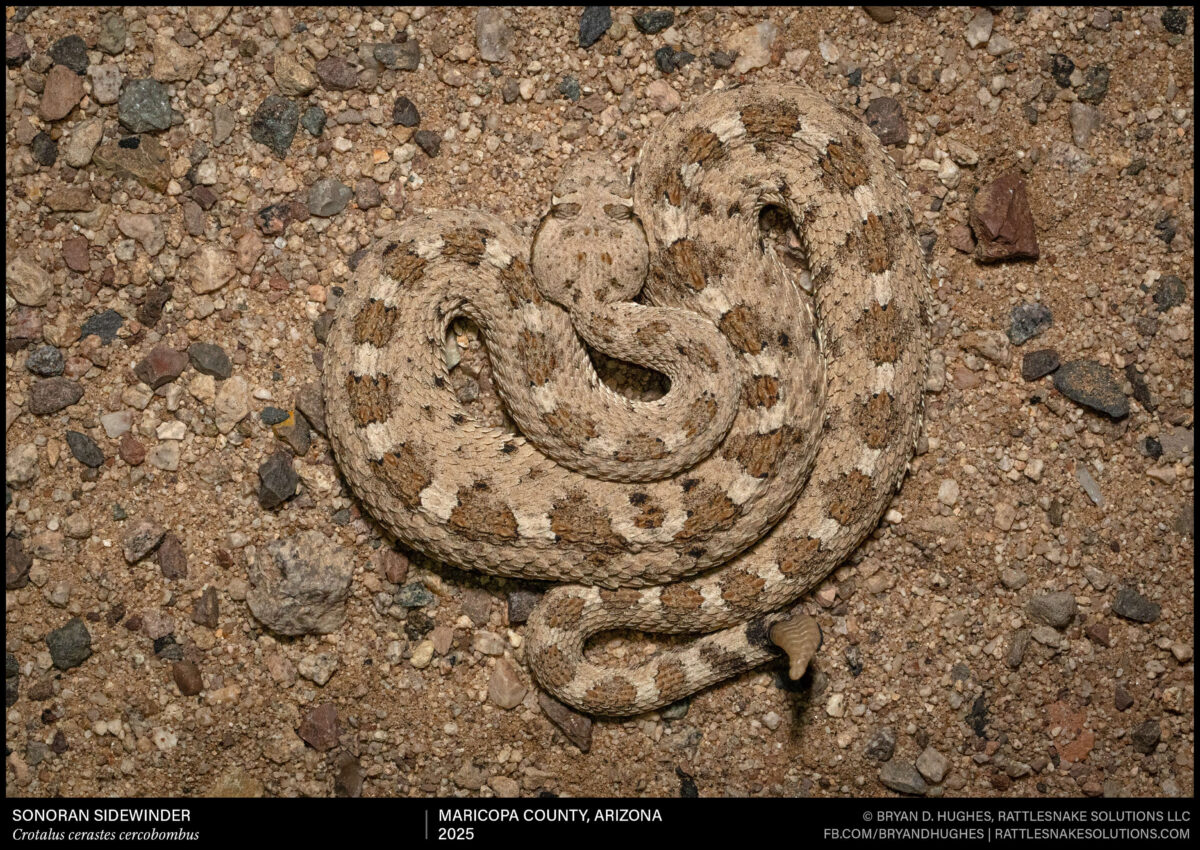

A young Sonoran Sidewinder (Crotalus cerastes cercobombus) with a nice, clean pattern near Phoenix last year. These small rattlesnakes are very common in the right habitat, but rarely seen by hikers because of the nature of that same habitat.
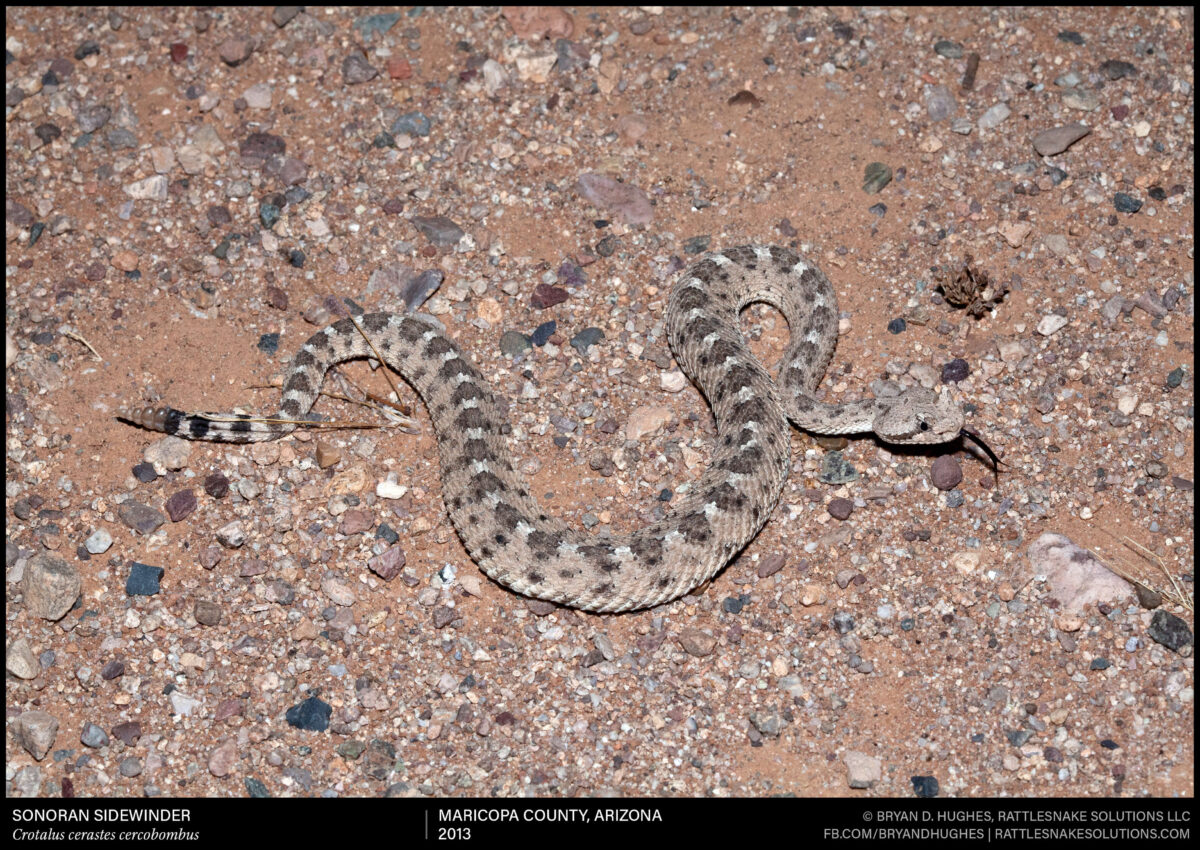
This is one of several Sonoran Sidewinders (Crotalus cerastes cercobombus) we found near Phoenix a while back on a hot night. These small rattlesnakes are abundant in the right habitat. Still, they are rarely seen by hikers, because the flat, sandy soil of the Colorado River subdivision of Sonoran Desert is rarely a scenic destination for hikers.
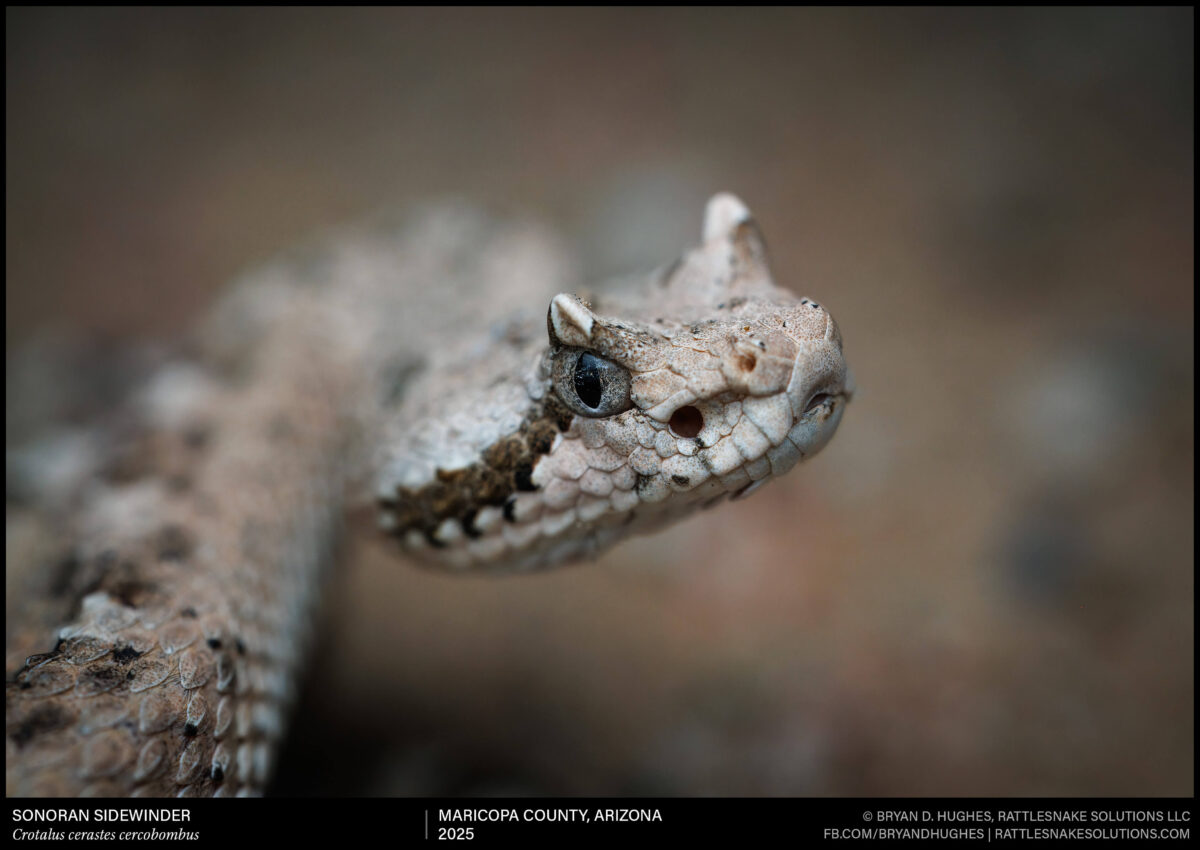
Close up with a Sonoran Sidewinder, showing off its “horns”. They are actually soft scales that rise above the eye, a feature they share convergently with unrelated vipers in deserts on the other side of the world. This is one of several seen on a warm evening last year near Phoenix.
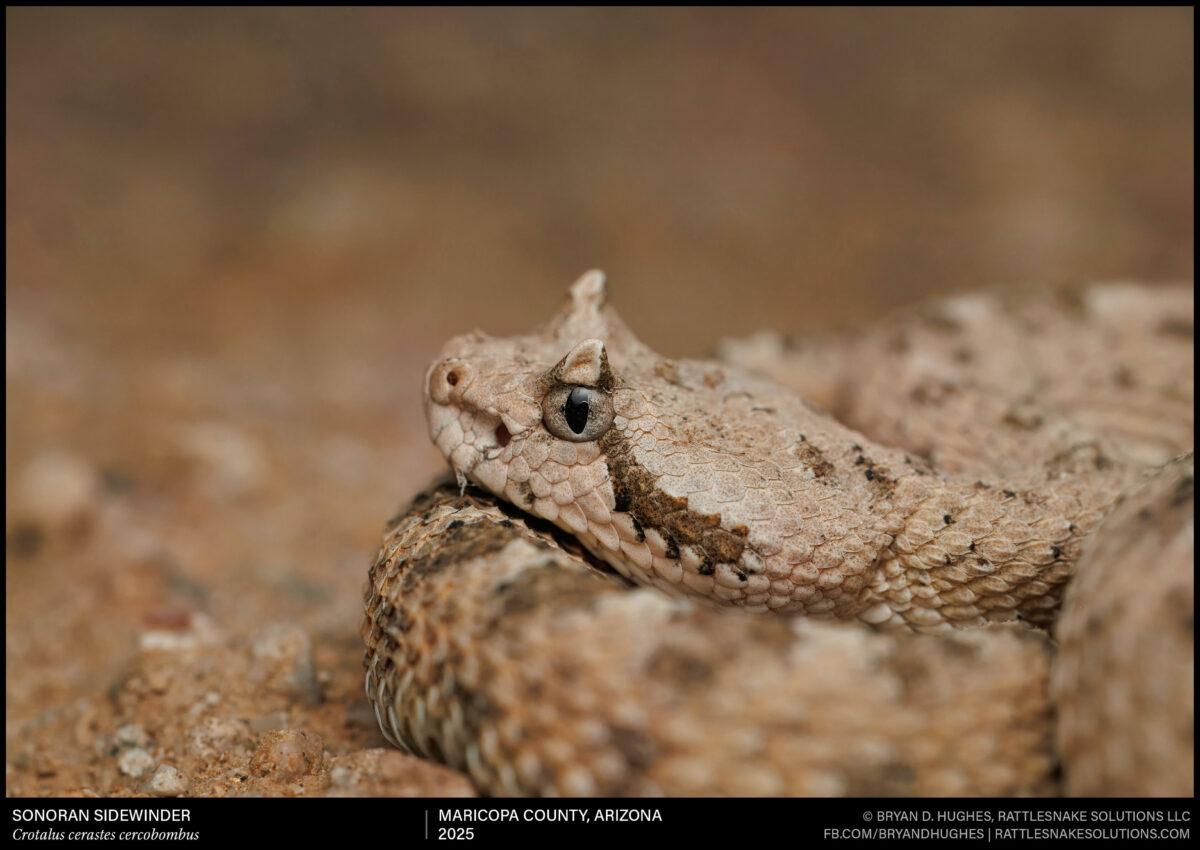
Sonoran Sidewinders are common snakes found in flat, sandy areas of southern Arizona. They used to inhabit nearly the entirety of the Phoenix metro valley, with records below Camelback Mountain and throughout Scottsdale. Of the rattlesnake species in the region, however, they are the first to die out as soon as an area is closed in by roads. This one was found near Phoenix in an area where they are still common, but future development will change that dramatically, soon.
cerastesA Sonoran Sidewinder that had just crossed a road west of Phoenix. These small specialist rattlesnakes are abundant in the right conditions. This is the reason that hikers will almost never come across one … the flat sandy habitat they need is nobody’s hiking destination.

Leavitt, D. J., & Grimsley, A. A. (2019). Density, recapture probability, biomass, productivity, and population structure of Sidewinders (Crotalus cerastes) in the Sonoran Desert of Arizona. Herpetology Notes, 12, 427–435. https://www.researchgate.net/publication/332802062
A Sonoran Sidewinder from the Phoenix area, out and about late at night as they tend to do. This one is large, for a small species, and for a male. These snakes are under two feet long, with females being slightly larger as full-grown adults. There are several reasons this may be the case, one of which being that a bigger snake can produce more babies.

These rattlesnakes don’t, and may not really be able to, slither like most snakes do. They can move in a straight line rectilinear motion, undulating belly muscles to inch forward. But more typically, they throw a loop of the body forward, past its head, and then bring the rest of the body alongside it. This is the side-winding method they’re named for. It’s a good way to move through a sandy, hot environment … often with some speed. The tracks left behind are a series of unconnected lines with a “J” at the end, pointing in the direction of travel. This is different than is often expected by homeowners, who report a “sidewinder tracks” that are typically from fast-moving nonvenomous snakes, like coachwhips and whipsnakes, moving quickly through soft matrix, leaving a swishing side to side track.
And yes, there are sidewinders elsewhere in the world … but they’re not closely related to these snakes, and are not rattlesnakes. They are a great example of convergent evolution, where a similar solution evolves to meet similar problems. In this case, it turns out that side-winding is a very efficient way to move for a snake, and sandy deserts on the other side of the world are no different.
Webber, M. M., Jezkova, T., Glaudas, X., & Rodríguez-Robles, J. A. (2016). Feeding ecology of sidewinder rattlesnakes, Crotalus cerastes (Viperidae). Herpetologica, 72(4), 324–330. https://doi.org/10.1655/Herpetologica-D-15-00042
Tingle, J. L., & Sherman, B. M. (2022). Scaling and relations of morphology with locomotor kinematics in the sidewinder rattlesnake Crotalus cerastes. Journal of Experimental Biology, 225(7), jeb243817. https://doi.org/10.1242/jeb.243817
Blomsten, P., Schuett, G. W., Höggren, M., & Clark, R. W. (2016). Fifteen consecutive years of successful reproduction in a captive female sidewinder (Crotalus cerastes). Herpetological Review, 47(2), 231–234. https://www.academia.edu/download/43375448/Blomsten_et_al_Sidewinder_Reproduction_HR_2016.pdf
Rautsaw, R. M., Hofmann, E. P., et al. (2019). Intraspecific sequence and gene expression variation contribute little to venom diversity in sidewinder rattlesnakes (Crotalus cerastes). Proceedings of the Royal Society B: Biological Sciences, 286(1902), 20190810. https://doi.org/10.1098/rspb.2019.0810
Webber, M. M., Glaudas, X., & Rodríguez-Robles, J. A. (2012). Do sidewinder rattlesnakes (Crotalus cerastes, Viperidae) cease feeding during the breeding season? Copeia, 2012(1), 100–105. https://doi.org/10.1643/CE-11-056
Leavitt, D. J., & Grimsley, A. A. (2019). Density, recapture probability, biomass, productivity, and population structure of sidewinders (Crotalus cerastes) in the Sonoran Desert of Arizona. Herpetology Notes, 12, 577–584. https://www.biotaxa.org/hn/article/view/35147/44449
I first saw the diagonal parallel track lines in the sand, and stopped the car to take look for who left them. Nearby, the track-owner was on the move: a male Sonoran Sidewinder (right). I recognized its behavior as tracking something … maybe food, a mate, etc. His head moved side to side, tongue flicking fast and touching the ground.
Maybe 20 seconds later – I saw what he was looking for, a larger, female Sonoran Sidewinder. She continued sidewinding out of the area, with him following close behind. She eventually settled under a bush, and his courting eventually paid off. They were still there mating hours later on the return trip.
Notable here: the male went in and out of the standard sidewinding motion and rectilinear (straight, belly crawl) movement when tracking. Sidewinding was again used to move more quickly and keep up with the female when she was on her way.


Sonoran Sidewinders can be incredibly common in the right habitat, but that doesn’t often put them in the path of homeowners in the Phoenix and Tucson areas. Of the six species of rattlesnakes that can be found at the native habitat contact zones, this species is the first to disappear whenever roads come in. They once spanned the entire Phoenix metro valley, found in the desert around the base of Camelback Mountain and as far north and east as Cave Creek and the foothills of Scottsdale. This one was found in an area that will become developed over the next decade, and this now dense population of snakes will likely disappear.

A Sonoran Sidewinder from a sandy area in the far western end of the range for this subspecies. This is an older adult, measuring around 18″ long.

A young Sonoran Sidewinder I found in central Arizona near the edge of their range. These small specialists can be found in relatively flat, sandy and grassy desert areas in the region, but their presence ends abruptly at the edges of mountains.
Sidewinder (Crotalus cerastes ssp.) https://rattlesnakesolutions.com/Sidewinder
