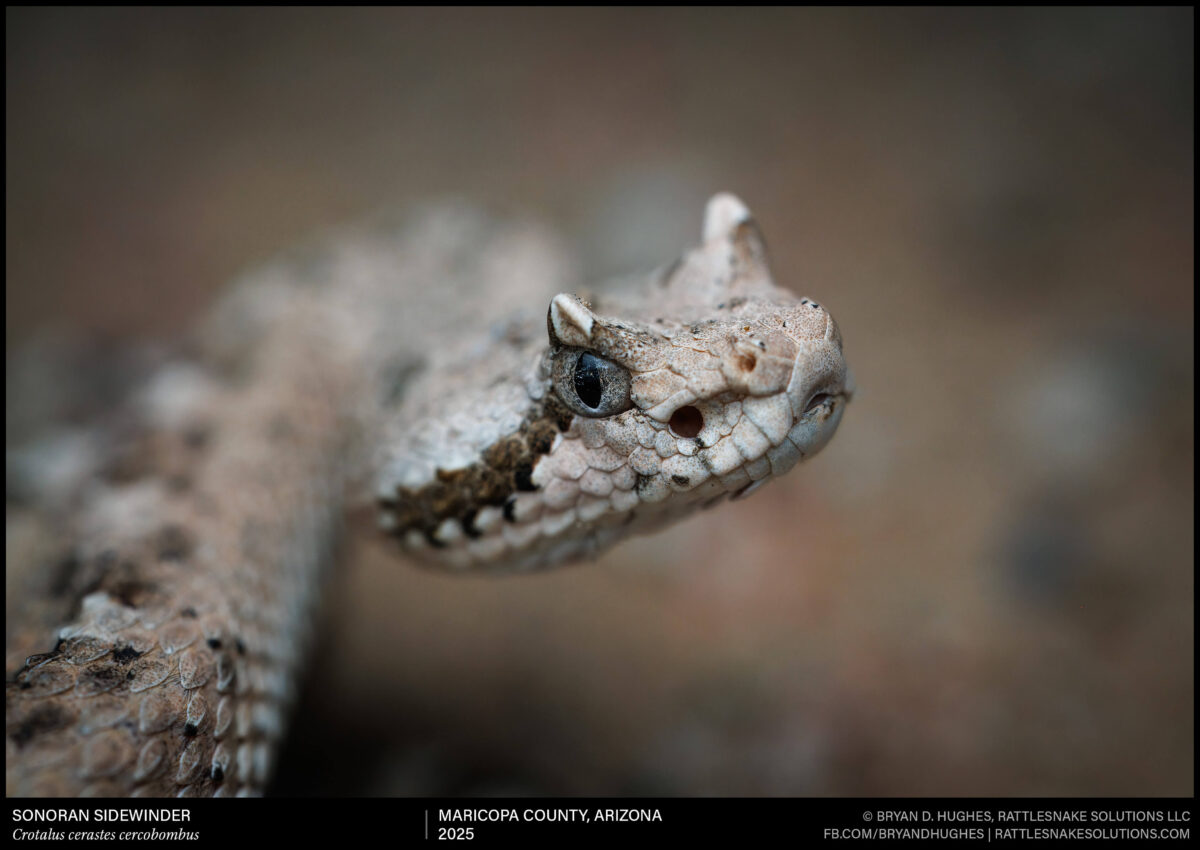
Close up with a Sonoran Sidewinder, showing off its “horns”. They are actually soft scales that rise above the eye, a feature they share convergently with unrelated vipers in deserts on the other side of the world. This is one of several seen on a warm evening last year near Phoenix.
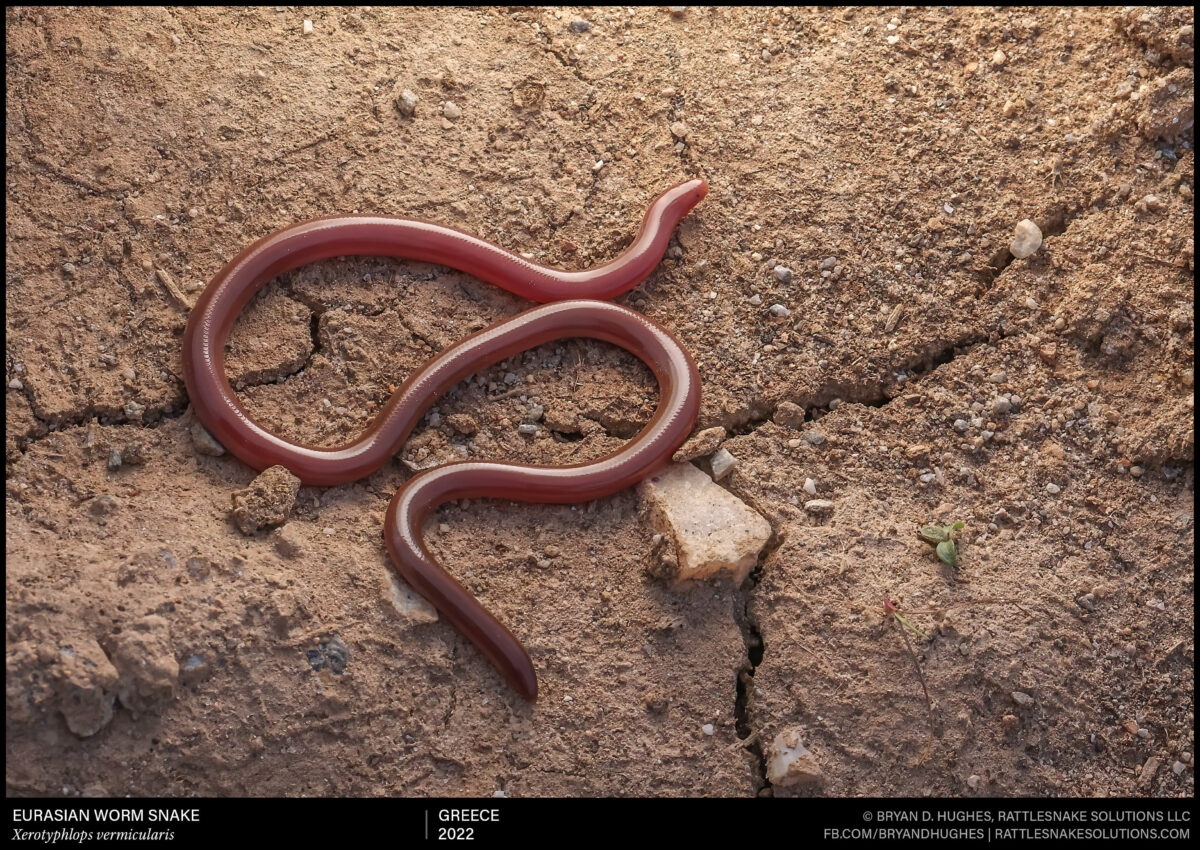
A Eurasian Worm Snake (Xerotyphlops vermicularis) we found in Greece a few years ago. Convergently, they’re very much like our more familiar threadsnakes in the southwestern US, though a bit thicker and easier to find. Just like ours, too, they’re about impossible to get a decent photograph.
A Sonoran Sidewinder from the Phoenix area, out and about late at night as they tend to do. This one is large, for a small species, and for a male. These snakes are under two feet long, with females being slightly larger as full-grown adults. There are several reasons this may be the case, one of which being that a bigger snake can produce more babies.
These rattlesnakes don’t, and may not really be able to, slither like most snakes do. They can move in a straight line rectilinear motion, undulating belly muscles to inch forward. But more typically, they throw a loop of the body forward, past its head, and then bring the rest of the body alongside it. This is the side-winding method they’re named for. It’s a good way to move through a sandy, hot environment … often with some speed. The tracks left behind are a series of unconnected lines with a “J” at the end, pointing in the direction of travel. This is different than is often expected by homeowners, who report a “sidewinder tracks” that are typically from fast-moving nonvenomous snakes, like coachwhips and whipsnakes, moving quickly through soft matrix, leaving a swishing side to side track.
And yes, there are sidewinders elsewhere in the world … but they’re not closely related to these snakes, and are not rattlesnakes. They are a great example of convergent evolution, where a similar solution evolves to meet similar problems. In this case, it turns out that side-winding is a very efficient way to move for a snake, and sandy deserts on the other side of the world are no different.
Webber, M. M., Jezkova, T., Glaudas, X., & Rodríguez-Robles, J. A. (2016). Feeding ecology of sidewinder rattlesnakes, Crotalus cerastes (Viperidae). Herpetologica, 72(4), 324–330. https://doi.org/10.1655/Herpetologica-D-15-00042
Tingle, J. L., & Sherman, B. M. (2022). Scaling and relations of morphology with locomotor kinematics in the sidewinder rattlesnake Crotalus cerastes. Journal of Experimental Biology, 225(7), jeb243817. https://doi.org/10.1242/jeb.243817
Blomsten, P., Schuett, G. W., Höggren, M., & Clark, R. W. (2016). Fifteen consecutive years of successful reproduction in a captive female sidewinder (Crotalus cerastes). Herpetological Review, 47(2), 231–234. https://www.academia.edu/download/43375448/Blomsten_et_al_Sidewinder_Reproduction_HR_2016.pdf
Rautsaw, R. M., Hofmann, E. P., et al. (2019). Intraspecific sequence and gene expression variation contribute little to venom diversity in sidewinder rattlesnakes (Crotalus cerastes). Proceedings of the Royal Society B: Biological Sciences, 286(1902), 20190810. https://doi.org/10.1098/rspb.2019.0810
Webber, M. M., Glaudas, X., & Rodríguez-Robles, J. A. (2012). Do sidewinder rattlesnakes (Crotalus cerastes, Viperidae) cease feeding during the breeding season? Copeia, 2012(1), 100–105. https://doi.org/10.1643/CE-11-056
Leavitt, D. J., & Grimsley, A. A. (2019). Density, recapture probability, biomass, productivity, and population structure of sidewinders (Crotalus cerastes) in the Sonoran Desert of Arizona. Herpetology Notes, 12, 577–584. https://www.biotaxa.org/hn/article/view/35147/44449
One of the Malabar Pitvipers we saw on night hikes in rainforests of Karnataka, India. Convergently, they were very similar in appearance and behavior to arboreal vipers I’ve seen in Central and South America.