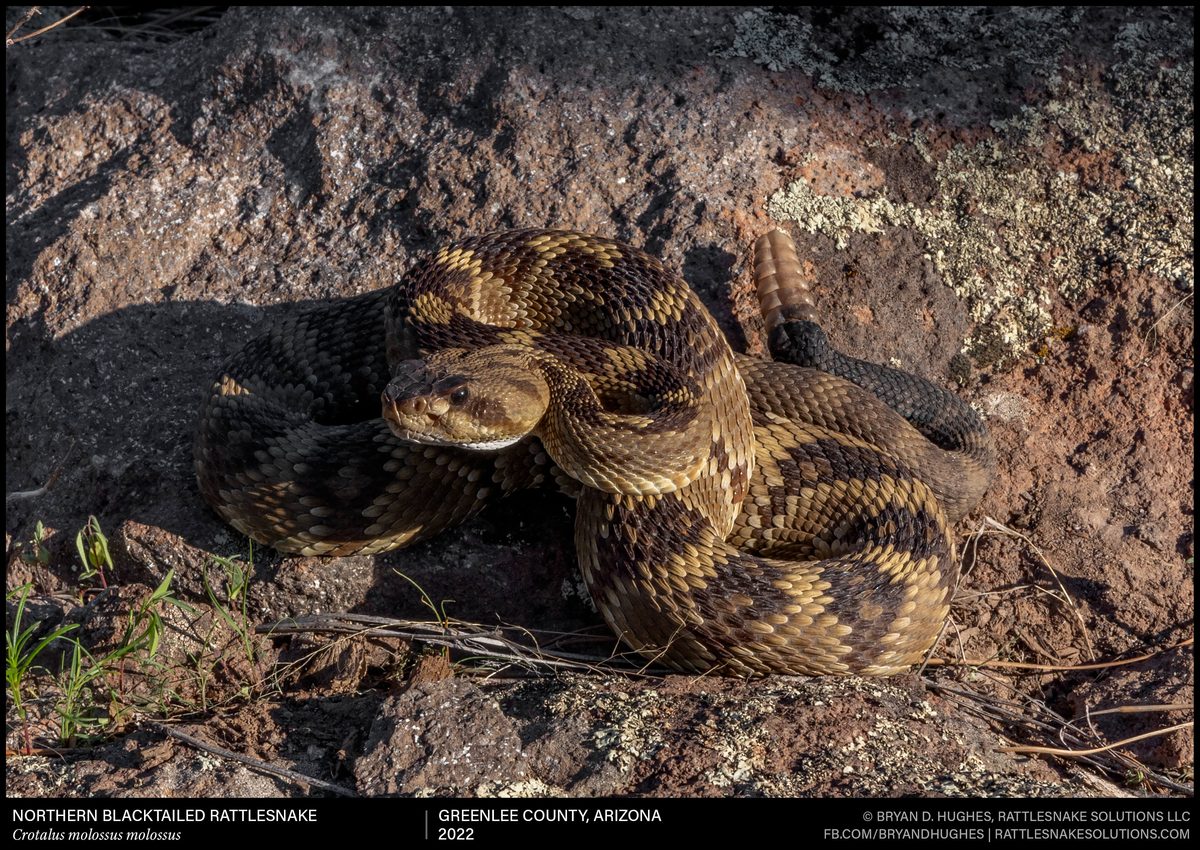
A large Blacktailed Rattlesnake that we found in the mountains of central Greenlee County. This is a huge, wild area with few roads and much of the high elevation habitat inaccessible without a lot of effort. For that reason, it’s of special interest to me, with relatively few examples of snakes compared to other regions in the state.
These are on the larger end of rattlesnakes in Arizona, reaching lengths of around four feet. Their defensive behavior is all over the board. Most of the large ones will quietly just continue to leave, making them even more difficult to photograph, as they seem to remain unbothered by the camera-holding primates.
Beck, D. D. (1995). Ecology and energetics of three sympatric rattlesnake species in the Sonoran Desert. Journal of Herpetology, 29(2), 211–223.
DOI: https://doi.org/10.2307/1564558
Pough, F. H. (1966). Ecological relationships of rattlesnakes in southeastern Arizona with notes on other species. Copeia.
DOI: https://doi.org/10.2307/1441401
Anderson, C. G., & Greenbaum, E. (2012). Phylogeography of northern populations of the Black-Tailed Rattlesnake (Crotalus molossus Baird and Girard, 1853), with the revalidation of C. ornatus Hallowell, 1854. Herpetological Monographs, 26(1), 19–57.
DOI: https://doi.org/10.1655/HERPMONOGRAPHS-D-11-00012.1