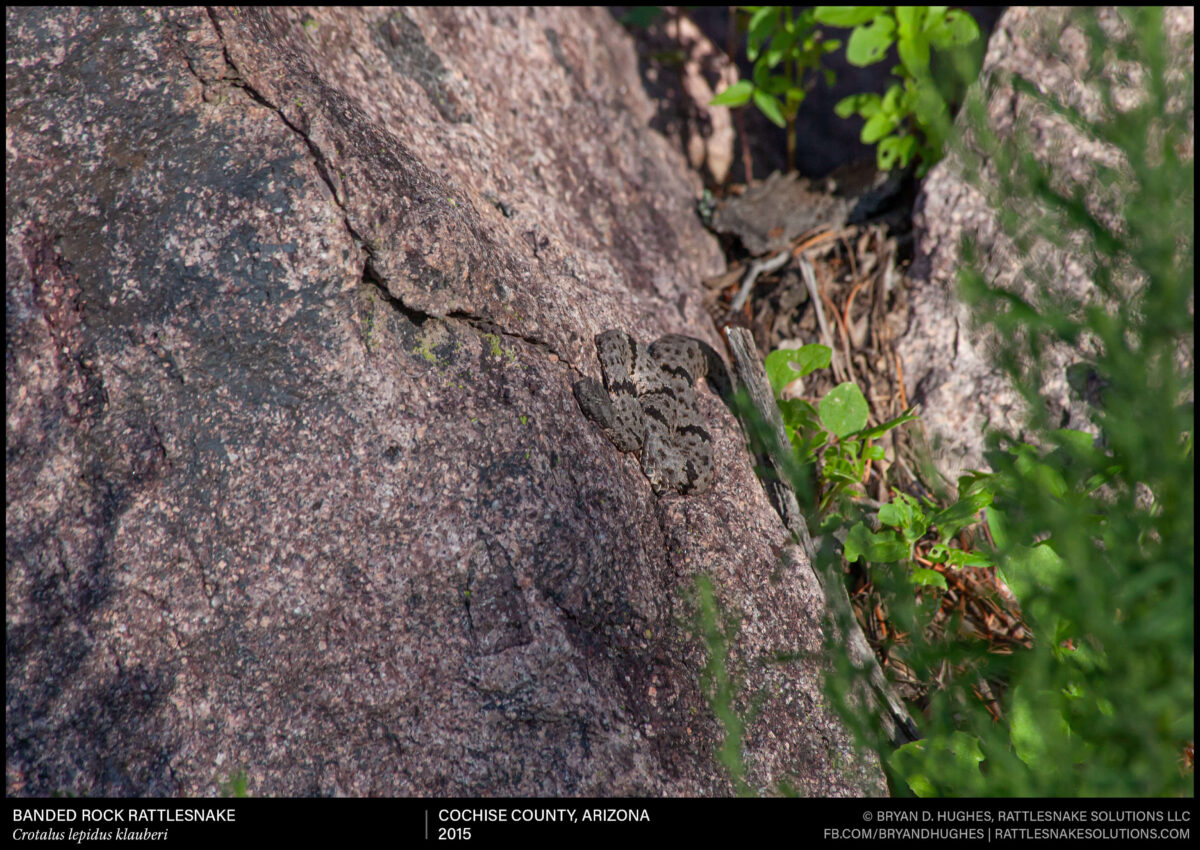
A small Banded Rock Rattlesnake in ambush along the base of a boulder in southeastern Arizona. The pattern and bands break up its shape, making it difficult to see in context. This is a good way to catch one of the many Yarrows Spiny Lizards jumping around on the same rocks each morning.
A mated pair of Banded Rock Rattlesnakes, tucked into rocks in a minor drainage in southeastern Arizona. During the late monsoon season, it’s not uncommon to find pairs or rattlesnakes like this, courting and mating in one rock pile while others are still giving birth elsewhere. The period of seasonal rain is the peak of activity for these animals, and a lot needs to be done in a relatively short period of time.
1.  Mata-Silva, V. (2011). Ecology of the Rock Rattlesnake (Crotalus lepidus) in the Northern Chihuahuan Desert. University of Texas at El Paso.
2. Mata-Silva, V., DeSantis, D.L., Wagler, A.E., et al. (2018). Spatial Ecology of Rock Rattlesnakes (Crotalus lepidus) in Far West Texas. Herpetologica, 74(3), 245–255.
https://doi.org/10.1655/Herpetologica-D-17-00091.1
A colorful Banded Rock Rattlesnake from southeastern Arizona. These small rattlesnakes, when encountered, almost always quickly flee. This may be accompanied by a high pitched rattle that could easily be ignored as a cicada, or not heard at all.
An interesting note on these snakes: of all of the ranchers, hunters, and cabin owners I’ve talked to in the field over the years, none of them have heard of this snake. Despite being exceedingly common in the right habitat, they’re apparently easy to miss or at least mistake as something else.
Banded Rock Rattlesnake from southeastern Arizona. These snakes, typically the males, can have a metallic blue-green shine along the back and outline of black bands, often against other bright pinks, blues, and orange. It matches the lichen covering rocks where they live. This one is a good example of a mature male of the species against the rocky backdrop of its habitat. From the uniform size of its rattle segments, it can be determined that it’s reached full size.
A Banded Rock Rattlesnake with a pink belly found in southeastern Arizona last year. These small snakes are quick to rattle but seldom stand their ground, opting to flee into bunchgrass or dive into jumbles of rock.