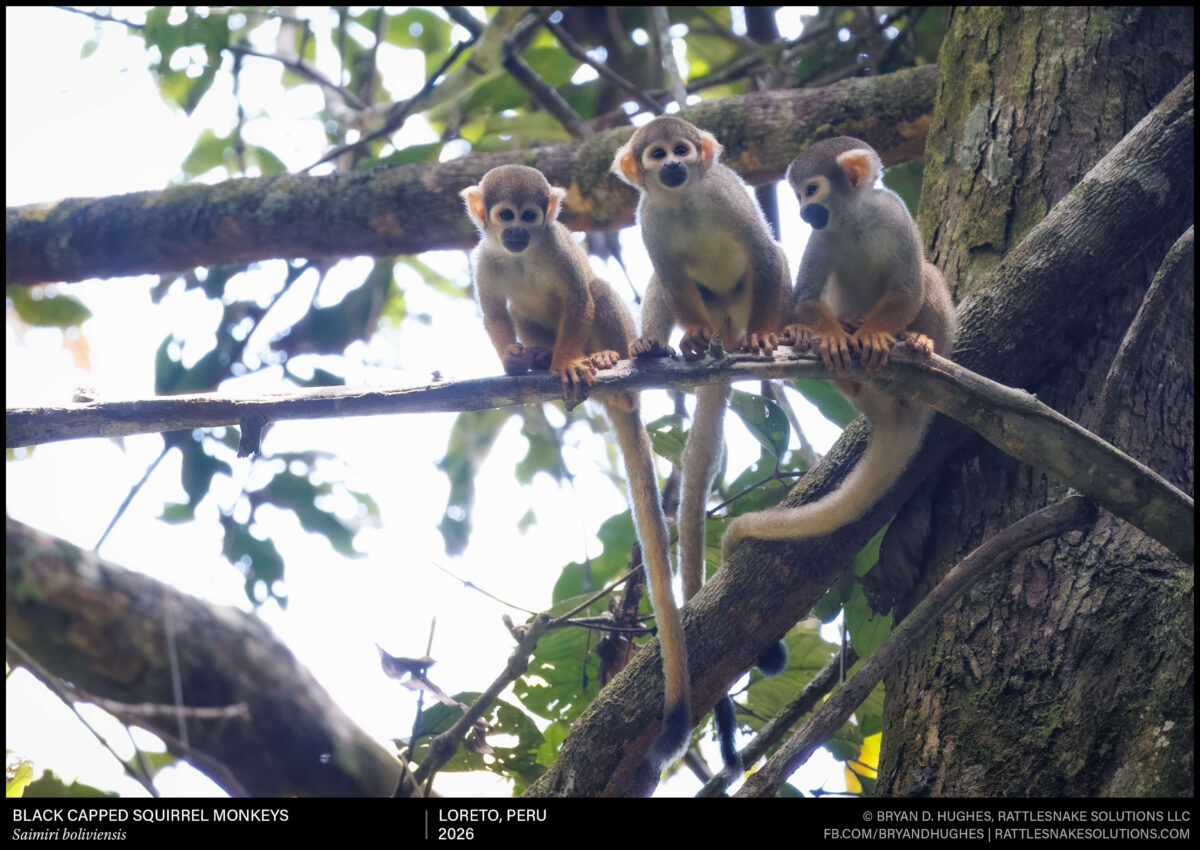
A trio of Black-Capped Squirrel Monkeys trying to make sense of visitors. Loreto, Peru, 2026.

The Tucuxi (Sotolia fluviatalis) is one of a handful of dolphins living throughout the Amazon River complex. This is not the more famous Boto (Pink River Dolphin), but is often found swimming in groups alongside them.

This was one of a few in such a mixed group, surfacing here and there with some larger Boto and a few other Tucuxi. I lucked out with this shot, having spent the morning on a boat trying out some previously unused features in my camera that help to more quickly find and focus on fast-moving targets (birds). We were near the water photographing a snake, and I got a series of snaps in, and this one just decided to show off a bit. I was not expecting my favorite take-home from a trip to the Amazon to find reptiles and amphibians to be a mammal, but here we are.
Martin, A. R., & da Silva, V. M. F. (2004).
Home range and movements of Amazon river dolphins (Inia geoffrensis) in the Amazon and Orinoco river basins. Marine Mammal Science, 20(3), 535–552.
da Silva, V. M. F. (1994). Aspects of the ecology of the Amazonian dolphins Inia geoffrensis and Sotalia fluviatilis. Journal of Mammalogy, 75(2), 300–308.
A metallic green jewel of the Amazon – Two-Striped Forest Pitviper, from Peru a few years back.

Amazon Harlequin Toad (Atelopus spumarius) from Peru a couple of years ago.

Collared Treerunners (Plica plica) are one of the larger arboreal lizards seen occasionally hiking in Peru. At night they sleep in trees, mostly high and out of sight. But sometimes they are in the understory and can be photographed.

A common and beautiful sight on night time walks in the Amazon, the Crowned False Boa. These are relatively small, usually around two feet in length, and aren’t biters. They eat lizards and other snakes, and the occasional frog, rodent, and bird. Usually when they’re seen, it’s moving through leaf litter on the ground as a flash of red half in and out of debris.

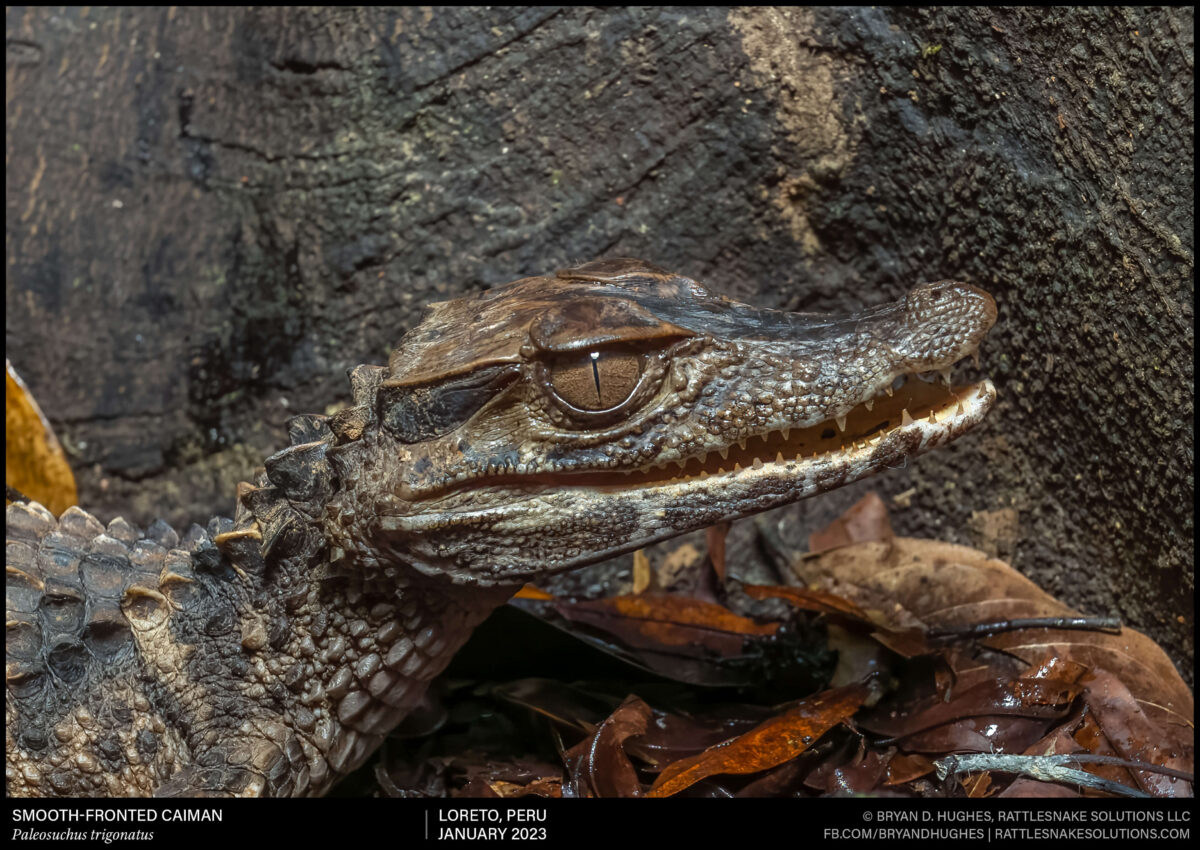
My favorite crocodilian, the Smooth-Fronted Caiman. These little guys live in smaller streams and hills in the rainforest, and have a lot of attitude for such a little guy. This one had no trouble at all letting my camera lens know who’s boss when it got a little too close. Got the shot first, though 🙂
One of the many forms of the Rhinella margaritifera complex sharing a spot above ground with a cluster of tiger beetles. Life on the ground in the Amazon can be a dangerous place, so it’s not uncommon to find animals spending time on leaves. In this case, the toad may be both trying to stay safe, or being that danger to the beetles.
I’ve seen tiger beetles cluster like this on leaves, which looks quite a bit from above like the typical holes in large leaves like this chewed by other insects. If it weren’t for the toad, I’d have passed by without a second glance.


